

Introduction
In today’s fast-moving and highly competitive digital world, businesses need smarter and more efficient ways to connect with their customers. Managing leads manually, sending emails one by one, and tracking customer interactions across different platforms can quickly become confusing and time-consuming. As a business grows, these challenges only increase, making it harder to maintain consistency and deliver a good customer experience.
This is where marketing automation combined with CRM (Customer Relationship Management) becomes a powerful solution. Instead of handling everything manually, businesses can automate repetitive tasks like email campaigns, follow-ups, and lead nurturing. This not only saves time but also ensures that no potential customer is missed.
A CRM system plays a key role by storing and organizing customer data in one place. It tracks every interaction, helping businesses understand customer behavior, preferences, and needs. When this data is used with marketing automation, it allows businesses to send the right message to the right person at the right time.
Together, marketing automation and CRM help improve efficiency, increase engagement, and build stronger relationships with customers. They also make it easier to track performance and make better decisions based on real data.
In simple terms, combining CRM with marketing automation helps businesses work smarter, not harder, and creates a strong foundation for long-term growth.
What is Marketing Automation?
Marketing Automation is the use of software and technology to handle repetitive marketing tasks automatically, instead of doing them manually every time. It helps businesses save time, reduce effort, and manage their marketing activities in a more organized way.
With marketing automation, tasks like email marketing campaigns, social media scheduling, lead nurturing, customer follow-ups, and campaign tracking can be set up once and run automatically. For example, when a user fills out a form, the system can instantly send a welcome email or assign the lead to a sales team without any manual action.
This not only improves efficiency but also ensures consistency in communication. Every customer receives timely and relevant messages based on their actions and behavior.
Instead of spending hours on repetitive work, businesses can focus more on planning strategies, creating better content, and improving campaign performance. It also allows teams to track results easily and make data-driven decisions.
In simple terms, marketing automation helps businesses work smarter by automating routine tasks and improving overall marketing effectiveness.
Key Benefits of Marketing Automation
Marketing automation offers several practical benefits that help businesses improve their overall marketing performance and efficiency. One of the biggest advantages is that it saves time and resources by handling repetitive tasks like emails, follow-ups, and campaign scheduling automatically. This allows teams to focus more on planning and strategy instead of manual work.
It also improves campaign efficiency by ensuring that marketing activities run smoothly without delays or errors. Automated workflows make sure that every step, from lead capture to follow-up, happens in a structured and timely manner.
Another important benefit is personalized communication. Marketing automation uses customer data to send relevant messages based on user behavior, interests, and stage in the buying journey. This makes communication more meaningful and increases engagement.
It also helps in increasing lead conversion rates. Since leads are nurtured with the right content at the right time, they are more likely to move forward in the sales process and become customers.
Finally, marketing automation provides data-driven insights. Businesses can track performance, analyze results, and understand what is working and what needs improvement, helping them make smarter decisions.
In simple terms, marketing automation helps businesses save time, improve results, and connect better with their audience.
What is CRM (Customer Relationship Management)?
A CRM (Customer Relationship Management) system is a software that helps businesses manage all their customer interactions in one place. It allows companies to store, organize, and track customer information throughout the entire customer journey, from the first contact to long-term relationship building.
Instead of using multiple tools or manual records, a CRM works as a centralized database where all important customer data is stored. This includes details like contact information, past purchases, communication history, and customer preferences. Having everything in one system makes it easier for teams to access information and provide better service.
With a CRM, businesses can clearly understand customer behavior and needs. It helps sales and marketing teams track interactions, follow up on leads, and build stronger relationships over time. This improves customer experience and increases the chances of repeat business.
In simple terms, a CRM system helps businesses stay organized, understand their customers better, and manage relationships more effectively for long-term growth.
Why CRM is Important
A CRM system plays a key role in helping businesses manage and grow their customer relationships effectively. It allows companies to understand customer behavior by tracking interactions, preferences, and past activities. This helps businesses know what their customers need and how they make decisions.
It also helps in improving customer engagement. With all data in one place, businesses can communicate in a more personalized and timely way, which makes customers feel valued and connected.
Another important benefit is that it strengthens long-term relationships. By maintaining consistent communication and understanding customer needs, businesses can build trust and loyalty over time.
Additionally, CRM supports better sales and marketing decisions. With clear data and insights, teams can plan strategies more effectively, target the right audience, and improve overall performance.
In simple terms, a CRM helps businesses understand, connect with, and retain their customers in a smarter way.
Combine Power of Marketing Automation and CRM
Marketing Automation CRM is a comprehensive system that merges the capabilities of Customer Relationship Management (CRM) with the efficiency of Marketing Automation tools. It’s a technological combination designed to simplify marketing efforts while fostering stronger, more personalized connections with customers. Integrating customer data from various touch-points into a centralized platform, it empowers businesses to automate marketing tasks, manage leads through the sales funnel, and deliver tailored communications.
This system enables the creation and execution of targeted campaigns across multiple channels, leveraging insights derived from customer behavior and preferences. Through automation, it optimizes workflows, allowing marketing teams to focus on strategy and creativity while ensuring consistent and meaningful interactions with customers. Ultimately, Marketing Automation CRM activates enhanced customer engagement, improved conversion rates, and data-driven decision-making, laying a robust foundation for sustainable business growth and success.
How It Works
When marketing automation is combined with CRM, the process becomes simple, structured, and highly effective. It starts with collecting customer data from multiple channels such as websites, social media, emails, and forms. This ensures that no interaction is missed.
All this data is then stored and organized in a centralized system, making it easy for teams to access and understand customer information in one place. With this data, the system can automatically send communication based on user behavior. For example, if a user shows interest in a product, they can receive relevant emails or follow-ups instantly.
At the same time, the CRM helps in tracking leads through the entire sales funnel, so businesses know exactly where each lead stands and what action is needed next. This improves coordination between marketing and sales teams.
Finally, businesses can deliver personalized campaigns, ensuring that each customer receives messages that match their needs and interests.
Key Outcomes
When marketing automation and CRM work together, they deliver strong and measurable results for businesses. One of the biggest outcomes is better customer engagement. Since communication is timely and personalized, customers feel more connected and are more likely to interact with the brand.
This also leads to higher conversion rates. When the right message reaches the right person at the right time, it increases the chances of turning leads into paying customers. Automated follow-ups and targeted campaigns play a key role here.
Another important result is improved customer retention. By staying connected with customers and understanding their needs, businesses can build long-term relationships and encourage repeat business.
Finally, it supports smarter decision-making. With access to real-time data and performance insights, businesses can analyze what is working and make better strategies for future campaigns.
In simple terms, this combination helps businesses engage better, convert more, retain customers, and make informed decisions for growth.
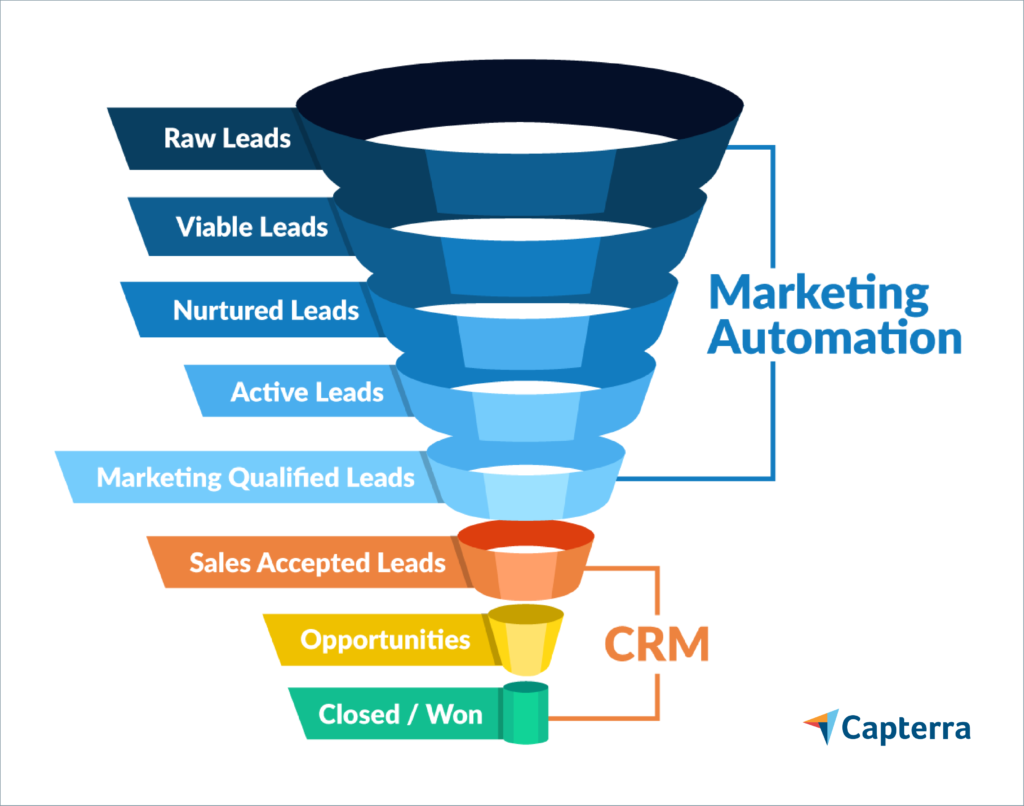
Features of marketing automation CRM
Integrated Client Information Hub
An automated Marketing CRM system helps unify a customer database by gathering information from different sources and organizing it neatly in one place. Imagine people interacting with a company through various channels like the website, social media, or emails.
Each interaction holds valuable details about the customer—what they like, how often they visit, what they purchase, and more. Instead of manually collecting and storing this information, the automated system does it automatically.
It grabs data from these different interactions and neatly arranges it in a single, centralized database. This unified database then gives a complete picture of each customer, making it easier for the company to understand their needs, preferences, and history of interactions across different channels.
Lead Tracking and Scoring System
In automated Marketing CRM, lead management involves tracking potential customers’ activities and scoring their level of interest. This scoring helps prioritize leads for personalized communication and follow-ups. As leads interact more, their scores change, indicating their readiness for a purchase. This system guides sales efforts toward leads showing higher interest, boosting the likelihood of turning them into customers.
Customer Segmentation
Automation in Marketing CRM simplifies Customer Segmentation by analyzing customer data and grouping individuals based on similarities like their buying habits or interests. This automatic categorization allows businesses to create personalized marketing strategies for different groups, improving the relevance of their messages and offers for better engagement.
Data Analysis and Performance Evaluation
Automation in Marketing CRM simplifies data collection and analysis, generating instant reports on campaign performance and customer behavior. This streamlined process enables quick, data-driven decision-making to refine strategies and enhance future marketing efforts.
Benefits of Marketing Automation CRM
Stronger Customer Relationships
It helps businesses keep all customer information organized. With this, they can talk to each person in a way they like and understand. By doing this, companies make customers happier and become friends with them. This makes people want to keep coming back to buy things from that company.
Better Lead Management and Conversion
The system keeps an eye on possible customers and gives them scores. This helps find the ones who might buy things. Then, it sends special messages and shows them things they like. Doing this makes it more likely they’ll become actual customers and buy from the company
Competitive Advantage
Using fancy tools to make things special for customers and sending them messages really helps a business stand out. When a company does more than expected for customers, it becomes different from all the other companies trying to sell similar things.
Scalability and Flexibility
Automation in marketing CRM supports scalability and flexibility by adapting to the changing needs and growth of a company. As the business expands, this system can handle larger volumes of customer data and increased demands. It’s like having a tool that grows alongside the company, accommodating more customers, and handling more tasks efficiently. Moreover, this system is flexible – it can be adjusted or modified to fit new requirements or incorporate additional functionalities. Its adaptability allows the business to evolve without worrying about outgrowing its tools, ensuring that the CRM system remains an asset that aligns with the company’s growth trajectory and changing needs.
Is Marketing Automation Cost-Effective?
Automation marketing and CRM can be very cost-effective for small businesses, especially when compared to the traditional methods of marketing and sales
Reduced labor costs: When you use technology to handle tasks like entering data, sending follow-up emails, or scoring leads, your team doesn’t have to spend as much time on these repetitive jobs. That means they can concentrate on more important things like creating exciting marketing plans or sealing deals. By doing this, you end up spending less money on paying employees to do routine tasks, which can help you save money over time.
Better customer service: CRM software helps you see everything about your customers in one place. This makes it easier to solve any problems they have faster. When you solve issues quickly, customers feel happier and more likely to stick with your business.
Scalability: So, as your company gets bigger, these systems can grow right along with it. You won’t need to find new ones because they’re built to handle more work as your business gets busier.
Popular Marketing Automation Platforms
Several platforms combine CRM and marketing automation to help businesses manage leads, campaigns, and customer relationships more effectively.
Two widely used options are HubSpot Marketing Hub and Zoho CRM. Both platforms offer a strong mix of automation tools and CRM capabilities, making them suitable for businesses of different sizes.
HubSpot Marketing Hub is known for its user-friendly interface and powerful features like email automation, lead tracking, and detailed analytics. It is especially popular among startups and growing businesses that want an all-in-one solution.
Zoho CRM, on the other hand, is a cost-effective and flexible platform that offers automation, sales tracking, and customization options. It is widely used by small to mid-sized businesses looking for a scalable solution.
HubSpot Marketing Hub
HubSpot Marketing Hub is one of the most popular all-in-one marketing automation platforms. It’s designed to help businesses attract, engage, and convert leads by combining CRM, automation, and analytics in a single system.
What It Does
At its core, HubSpot Marketing Hub helps you:
- Capture leads (forms, landing pages, chat)
- Automate marketing campaigns (email workflows, sequences)
- Track customer interactions across channels
- Analyze performance with detailed reports
- Personalize communication based on user behavior
It’s tightly integrated with HubSpot’s free CRM, so all customer data stays centralized.
Pricing Overview (2025–2026)
HubSpot offers multiple tiers depending on business size:
- Free Plan – Basic tools (email, forms, CRM)
- Starter – ~₹800–₹1,200/month per user (basic automation)
- Professional – ~₹65,000+/month (advanced automation & reporting)
- Enterprise – ₹3L+/month (advanced analytics & scalability)
Pricing depends on:
- Number of contacts
- Number of users (seats)
- Add-ons and features
Pros
- Easy to use (very beginner-friendly UI)
- All-in-one platform (no need for multiple tools)
- Strong automation and reporting
- Free CRM included
Cons
- Gets expensive as your contact list grows
- Advanced features locked in higher plans
- Onboarding cost for premium plans
When Should You Use It?
HubSpot Marketing Hub is ideal if:
- You want one platform for marketing + CRM
- You’re scaling your business and need automation
- You prefer ease of use over technical complexity
Zoho CRM
Zoho CRM is a cloud-based Customer Relationship Management platform that helps businesses manage sales, marketing, and customer support activities in one unified system.
It provides a centralized database where businesses can store and manage:
- Customer contact information
- Sales pipeline and deals
- Communication history (emails, calls, meetings)
- Customer behavior and engagement data
Zoho CRM also includes built-in marketing automation tools that help businesses capture, nurture, and convert leads efficiently.
Key Features
- Lead Management & Scoring – Identify and prioritize high-quality leads
- Customer Segmentation – Group customers based on behavior, location, or interests
- Email Campaigns & Automation – Send targeted and automated emails to prospects
- Web Forms Integration – Capture leads directly from websites and landing pages
- Campaign Tracking & ROI Analysis – Measure performance and effectiveness of marketing campaigns
- Sales & Marketing Alignment – Seamless data sharing between marketing and sales teams
Why Businesses Use Zoho CRM
- Affordable and scalable for small to medium businesses
- Strong integration with the Zoho ecosystem and third-party tools
- Helps automate repetitive tasks and improve productivity
- Enables personalized customer engagement across the lifecycle
In simple terms, Zoho CRM is an all-in-one solution that combines CRM and marketing automation to help businesses generate leads, nurture relationships, and drive conversions more effectively.
Final Thoughts
The combination of Marketing Automation and CRM is no longer optional. It has become a core requirement for businesses that want to stay competitive and grow in a structured, scalable way.
When businesses rely on manual processes, they often struggle with inconsistent communication, missed follow-ups, and scattered customer data. By integrating marketing automation with CRM, these challenges are replaced with streamlined workflows, centralized data management, and consistent customer engagement.
Automation reduces the burden of repetitive tasks such as email campaigns, lead nurturing, and follow-ups. At the same time, CRM ensures that every customer interaction is tracked, organized, and used to deliver more personalized experiences. This combination allows businesses to understand their audience better and respond with the right message at the right time.
The result is improved marketing performance, higher conversion rates, and stronger customer relationships. Teams can focus more on strategy and growth rather than operational tasks, leading to better productivity and efficiency.
For businesses aiming to scale, this integration provides a clear advantage. It supports data-driven decision-making, improves customer retention, and creates a foundation for long-term growth.
In simple terms, if your goal is to increase conversions, optimize marketing efforts, and build lasting customer loyalty, investing in marketing automation integrated with CRM is a smart and future-ready decision.
FAQs
What is marketing automation CRM ?
Marketing automation CRM is a unified system that combines customer relationship management with automation tools. It helps businesses manage customer data, track interactions, and automate marketing activities such as email campaigns, lead nurturing, and follow-ups-all from a single platform. This ensures better organization, improved efficiency, and more personalized communication.
Is marketing automation and CRM right for my small business?
Yes, marketing automation is highly suitable for small businesses. It helps reduce manual work, saves time, and allows teams to focus on growth strategies. With automation, small businesses can manage leads more effectively, maintain consistent communication, and deliver personalized experiences without needing large teams or resources.
How much do marketing automation and CRM cost?
The cost of marketing automation varies based on features, number of users, and business size. Many platforms offer flexible pricing models, starting from affordable plans for small businesses to advanced enterprise solutions with premium features. Businesses can choose a plan that fits their budget and scale as they grow.
Which are the Marketing Automation Platforms?
The best platform depends on your business requirements, budget, and scalability needs. Popular options include HubSpot Marketing Hub for its all-in-one capabilities and ease of use, and Zoho CRM for its affordability and strong integration ecosystem. Both offer powerful tools to manage and automate marketing effectively.
How does Marketing Automation improve lead generation?
Marketing automation helps capture and nurture leads through automated workflows, landing pages, and targeted campaigns. It ensures that potential customers receive timely and relevant content, increasing the chances of conversion.
Can Marketing Automation replace human interaction?
No, marketing automation is designed to support—not replace—human interaction. It handles repetitive tasks while allowing teams to focus on building meaningful relationships and closing deals.
Is technical knowledge required to use Marketing Automation tools?
Most modern tools are user-friendly and designed for non-technical users. Platforms like HubSpot Marketing Hub and Zoho CRM offer intuitive interfaces, tutorials, and support to help users get started
How long does it take to see results from Marketing Automation?
Results can vary, but most businesses start seeing improvements in engagement and lead management within a few weeks. Significant results, such as increased conversions and revenue growth, typically take a few months.
What types of businesses benefit from Marketing Automation?
Marketing automation is beneficial for businesses of all sizes and industries, including e-commerce, SaaS, education, healthcare, and service-based companies. Any business that manages leads and customer interactions can benefit from it.
Can Marketing Automation integrate with other tools?
Yes, most marketing automation platforms integrate seamlessly with tools like email services, social media platforms, analytics tools, and ERP systems. This ensures smooth data flow and better coordination across different business functions.


