Power of Marketing Automation and CRM – Complete Guide for Businesses
In today’s fast-moving and highly competitive digital world, businesses need smarter and more efficient ways to connect with their customers. Managing leads manually, sending emails one by one, and tracking customer interactions across different platforms can quickly become confusing and time-consuming. As a business grows, these challenges only increase, making it harder to maintain consistency and deliver a good customer experience.
This is where marketing automation combined with CRM (Customer Relationship Management) becomes a powerful solution. Instead of handling everything manually, businesses can automate repetitive tasks like email campaigns, follow-ups, and lead nurturing. This not only saves time but also ensures that no potential customer is missed.
A CRM system plays a key role by storing and organizing customer data in one place. It tracks every interaction, helping businesses understand customer behavior, preferences, and needs. When this data is used with marketing automation, it allows businesses to send the right message to the right person at the right time.
Together, marketing automation and CRM help improve efficiency, increase engagement, and build stronger relationships with customers. They also make it easier to track performance and make better decisions based on real data.
In simple terms, combining CRM with marketing automation helps businesses work smarter, not harder, and creates a strong foundation for long-term growth.
What is Marketing Automation?
Marketing Automation is the use of software and technology to handle repetitive marketing tasks automatically, instead of doing them manually every time. It helps businesses save time, reduce effort, and manage their marketing activities in a more organized way.
With marketing automation, tasks like email marketing campaigns, social media scheduling, lead nurturing, customer follow-ups, and campaign tracking can be set up once and run automatically. For example, when a user fills out a form, the system can instantly send a welcome email or assign the lead to a sales team without any manual action.
This not only improves efficiency but also ensures consistency in communication. Every customer receives timely and relevant messages based on their actions and behavior.
Instead of spending hours on repetitive work, businesses can focus more on planning strategies, creating better content, and improving campaign performance. It also allows teams to track results easily and make data-driven decisions.
In simple terms, marketing automation helps businesses work smarter by automating routine tasks and improving overall marketing effectiveness.
Key Benefits of Marketing Automation
Marketing automation offers several practical benefits that help businesses improve their overall marketing performance and efficiency. One of the biggest advantages is that it saves time and resources by handling repetitive tasks like emails, follow-ups, and campaign scheduling automatically. This allows teams to focus more on planning and strategy instead of manual work.
It also improves campaign efficiency by ensuring that marketing activities run smoothly without delays or errors. Automated workflows make sure that every step, from lead capture to follow-up, happens in a structured and timely manner.
Another important benefit is personalized communication. Marketing automation uses customer data to send relevant messages based on user behavior, interests, and stage in the buying journey. This makes communication more meaningful and increases engagement.
It also helps in increasing lead conversion rates. Since leads are nurtured with the right content at the right time, they are more likely to move forward in the sales process and become customers.
Finally, marketing automation provides data-driven insights. Businesses can track performance, analyze results, and understand what is working and what needs improvement, helping them make smarter decisions.
In simple terms, marketing automation helps businesses save time, improve results, and connect better with their audience.
What is CRM (Customer Relationship Management)?
A CRM (Customer Relationship Management) system is a software that helps businesses manage all their customer interactions in one place. It allows companies to store, organize, and track customer information throughout the entire customer journey, from the first contact to long-term relationship building.
Instead of using multiple tools or manual records, a CRM works as a centralized database where all important customer data is stored. This includes details like contact information, past purchases, communication history, and customer preferences. Having everything in one system makes it easier for teams to access information and provide better service.
With a CRM, businesses can clearly understand customer behavior and needs. It helps sales and marketing teams track interactions, follow up on leads, and build stronger relationships over time. This improves customer experience and increases the chances of repeat business.
In simple terms, a CRM system helps businesses stay organized, understand their customers better, and manage relationships more effectively for long-term growth.
Why CRM is Important
A CRM system plays a key role in helping businesses manage and grow their customer relationships effectively. It allows companies to understand customer behavior by tracking interactions, preferences, and past activities. This helps businesses know what their customers need and how they make decisions.
It also helps in improving customer engagement. With all data in one place, businesses can communicate in a more personalized and timely way, which makes customers feel valued and connected.
Another important benefit is that it strengthens long-term relationships. By maintaining consistent communication and understanding customer needs, businesses can build trust and loyalty over time.
Additionally, CRM supports better sales and marketing decisions. With clear data and insights, teams can plan strategies more effectively, target the right audience, and improve overall performance.
In simple terms, a CRM helps businesses understand, connect with, and retain their customers in a smarter way.
Combine Power of Marketing Automation and CRM
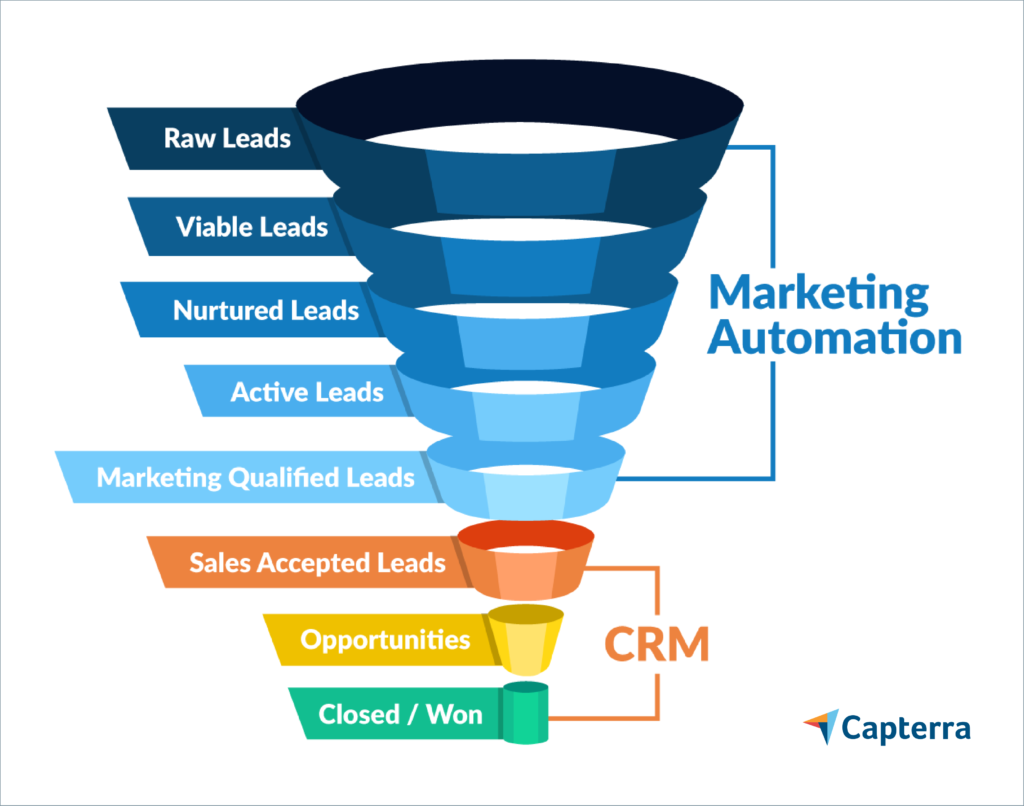
Marketing Automation CRM is a comprehensive system that merges the capabilities of Customer Relationship Management (CRM) with the efficiency of Marketing Automation tools. It’s a technological combination designed to simplify marketing efforts while fostering stronger, more personalized connections with customers. Integrating customer data from various touch-points into a centralized platform, it empowers businesses to automate marketing tasks, manage leads through the sales funnel, and deliver tailored communications.
This system enables the creation and execution of targeted campaigns across multiple channels, leveraging insights derived from customer behavior and preferences. Through automation, it optimizes workflows, allowing marketing teams to focus on strategy and creativity while ensuring consistent and meaningful interactions with customers. Ultimately, Marketing Automation CRM activates enhanced customer engagement, improved conversion rates, and data-driven decision-making, laying a robust foundation for sustainable business growth and success.
How It Works
When marketing automation is combined with CRM, the process becomes simple, structured, and highly effective. It starts with collecting customer data from multiple channels such as websites, social media, emails, and forms. This ensures that no interaction is missed.
All this data is then stored and organized in a centralized system, making it easy for teams to access and understand customer information in one place. With this data, the system can automatically send communication based on user behavior. For example, if a user shows interest in a product, they can receive relevant emails or follow-ups instantly.
At the same time, the CRM helps in tracking leads through the entire sales funnel, so businesses know exactly where each lead stands and what action is needed next. This improves coordination between marketing and sales teams.
Finally, businesses can deliver personalized campaigns, ensuring that each customer receives messages that match their needs and interests.
Key Outcomes
When marketing automation and CRM work together, they deliver strong and measurable results for businesses. One of the biggest outcomes is better customer engagement. Since communication is timely and personalized, customers feel more connected and are more likely to interact with the brand.
This also leads to higher conversion rates. When the right message reaches the right person at the right time, it increases the chances of turning leads into paying customers. Automated follow-ups and targeted campaigns play a key role here.
Another important result is improved customer retention. By staying connected with customers and understanding their needs, businesses can build long-term relationships and encourage repeat business.
Finally, it supports smarter decision-making. With access to real-time data and performance insights, businesses can analyze what is working and make better strategies for future campaigns.
In simple terms, this combination helps businesses engage better, convert more, retain customers, and make informed decisions for growth.
Features of marketing automation CRM
Integrated Client Information Hub
An automated Marketing CRM system helps unify a customer database by gathering information from different sources and organizing it neatly in one place. Imagine people interacting with a company through various channels like the website, social media, or emails.
Each interaction holds valuable details about the customer—what they like, how often they visit, what they purchase, and more. Instead of manually collecting and storing this information, the automated system does it automatically.
It grabs data from these different interactions and neatly arranges it in a single, centralized database. This unified database then gives a complete picture of each customer, making it easier for the company to understand their needs, preferences, and history of interactions across different channels.
Lead Tracking and Scoring System
In automated Marketing CRM, lead management involves tracking potential customers’ activities and scoring their level of interest. This scoring helps prioritize leads for personalized communication and follow-ups. As leads interact more, their scores change, indicating their readiness for a purchase. This system guides sales efforts toward leads showing higher interest, boosting the likelihood of turning them into customers.
Customer Segmentation
Automation in Marketing CRM simplifies Customer Segmentation by analyzing customer data and grouping individuals based on similarities like their buying habits or interests. This automatic categorization allows businesses to create personalized marketing strategies for different groups, improving the relevance of their messages and offers for better engagement.
Data Analysis and Performance Evaluation
Automation in Marketing CRM simplifies data collection and analysis, generating instant reports on campaign performance and customer behavior. This streamlined process enables quick, data-driven decision-making to refine strategies and enhance future marketing efforts.
Benefits of Marketing Automation CRM
Stronger Customer Relationships
It helps businesses keep all customer information organized. With this, they can talk to each person in a way they like and understand. By doing this, companies make customers happier and become friends with them. This makes people want to keep coming back to buy things from that company.
Better Lead Management and Conversion
The system keeps an eye on possible customers and gives them scores. This helps find the ones who might buy things. Then, it sends special messages and shows them things they like. Doing this makes it more likely they’ll become actual customers and buy from the company
Competitive Advantage
Using fancy tools to make things special for customers and sending them messages really helps a business stand out. When a company does more than expected for customers, it becomes different from all the other companies trying to sell similar things.
Scalability and Flexibility
Automation in marketing CRM supports scalability and flexibility by adapting to the changing needs and growth of a company. As the business expands, this system can handle larger volumes of customer data and increased demands. It’s like having a tool that grows alongside the company, accommodating more customers, and handling more tasks efficiently. Moreover, this system is flexible – it can be adjusted or modified to fit new requirements or incorporate additional functionalities. Its adaptability allows the business to evolve without worrying about outgrowing its tools, ensuring that the CRM system remains an asset that aligns with the company’s growth trajectory and changing needs.
Is Marketing Automation Cost-Effective?
Automation marketing and CRM can be very cost-effective for small businesses, especially when compared to the traditional methods of marketing and sales
Reduced labor costs: When you use technology to handle tasks like entering data, sending follow-up emails, or scoring leads, your team doesn’t have to spend as much time on these repetitive jobs. That means they can concentrate on more important things like creating exciting marketing plans or sealing deals. By doing this, you end up spending less money on paying employees to do routine tasks, which can help you save money over time.
Better customer service: CRM software helps you see everything about your customers in one place. This makes it easier to solve any problems they have faster. When you solve issues quickly, customers feel happier and more likely to stick with your business.
Scalability: So, as your company gets bigger, these systems can grow right along with it. You won’t need to find new ones because they’re built to handle more work as your business gets busier.
Popular Marketing Automation Platforms
Several platforms combine CRM and marketing automation to help businesses manage leads, campaigns, and customer relationships more effectively.
Two widely used options are HubSpot Marketing Hub and Zoho CRM. Both platforms offer a strong mix of automation tools and CRM capabilities, making them suitable for businesses of different sizes.
HubSpot Marketing Hub is known for its user-friendly interface and powerful features like email automation, lead tracking, and detailed analytics. It is especially popular among startups and growing businesses that want an all-in-one solution.
Zoho CRM, on the other hand, is a cost-effective and flexible platform that offers automation, sales tracking, and customization options. It is widely used by small to mid-sized businesses looking for a scalable solution.
HubSpot Marketing Hub
HubSpot Marketing Hub is one of the most popular all-in-one marketing automation platforms. It’s designed to help businesses attract, engage, and convert leads by combining CRM, automation, and analytics in a single system.
What It Does
At its core, HubSpot Marketing Hub helps you:
- Capture leads (forms, landing pages, chat)
- Automate marketing campaigns (email workflows, sequences)
- Track customer interactions across channels
- Analyze performance with detailed reports
- Personalize communication based on user behavior
It’s tightly integrated with HubSpot’s free CRM, so all customer data stays centralized.
Pricing Overview (2025–2026)
HubSpot offers multiple tiers depending on business size:
- Free Plan – Basic tools (email, forms, CRM)
- Starter – ~₹800–₹1,200/month per user (basic automation)
- Professional – ~₹65,000+/month (advanced automation & reporting)
- Enterprise – ₹3L+/month (advanced analytics & scalability)
Pricing depends on:
- Number of contacts
- Number of users (seats)
- Add-ons and features
Pros
- Easy to use (very beginner-friendly UI)
- All-in-one platform (no need for multiple tools)
- Strong automation and reporting
- Free CRM included
Cons
- Gets expensive as your contact list grows
- Advanced features locked in higher plans
- Onboarding cost for premium plans
When Should You Use It?
HubSpot Marketing Hub is ideal if:
- You want one platform for marketing + CRM
- You’re scaling your business and need automation
- You prefer ease of use over technical complexity
Zoho CRM
Zoho CRM is a cloud-based Customer Relationship Management platform that helps businesses manage sales, marketing, and customer support activities in one unified system.
It provides a centralized database where businesses can store and manage:
- Customer contact information
- Sales pipeline and deals
- Communication history (emails, calls, meetings)
- Customer behavior and engagement data
Zoho CRM also includes built-in marketing automation tools that help businesses capture, nurture, and convert leads efficiently.
Key Features
- Lead Management & Scoring – Identify and prioritize high-quality leads
- Customer Segmentation – Group customers based on behavior, location, or interests
- Email Campaigns & Automation – Send targeted and automated emails to prospects
- Web Forms Integration – Capture leads directly from websites and landing pages
- Campaign Tracking & ROI Analysis – Measure performance and effectiveness of marketing campaigns
- Sales & Marketing Alignment – Seamless data sharing between marketing and sales teams
Why Businesses Use Zoho CRM
- Affordable and scalable for small to medium businesses
- Strong integration with the Zoho ecosystem and third-party tools
- Helps automate repetitive tasks and improve productivity
- Enables personalized customer engagement across the lifecycle
In simple terms, Zoho CRM is an all-in-one solution that combines CRM and marketing automation to help businesses generate leads, nurture relationships, and drive conversions more effectively.
Final Thoughts
The combination of Marketing Automation and CRM is no longer optional. It has become a core requirement for businesses that want to stay competitive and grow in a structured, scalable way.
When businesses rely on manual processes, they often struggle with inconsistent communication, missed follow-ups, and scattered customer data. By integrating marketing automation with CRM, these challenges are replaced with streamlined workflows, centralized data management, and consistent customer engagement.
Automation reduces the burden of repetitive tasks such as email campaigns, lead nurturing, and follow-ups. At the same time, CRM ensures that every customer interaction is tracked, organized, and used to deliver more personalized experiences. This combination allows businesses to understand their audience better and respond with the right message at the right time.
The result is improved marketing performance, higher conversion rates, and stronger customer relationships. Teams can focus more on strategy and growth rather than operational tasks, leading to better productivity and efficiency.
For businesses aiming to scale, this integration provides a clear advantage. It supports data-driven decision-making, improves customer retention, and creates a foundation for long-term growth.
In simple terms, if your goal is to increase conversions, optimize marketing efforts, and build lasting customer loyalty, investing in marketing automation integrated with CRM is a smart and future-ready decision.
FAQs
-
What is marketing automation CRM ?
Marketing automation CRM is a unified system that combines customer relationship management with automation tools. It helps businesses manage customer data, track interactions, and automate marketing activities such as email campaigns, lead nurturing, and follow-ups-all from a single platform. This ensures better organization, improved efficiency, and more personalized communication.
-
Is marketing automation and CRM right for my small business?
Yes, marketing automation is highly suitable for small businesses. It helps reduce manual work, saves time, and allows teams to focus on growth strategies. With automation, small businesses can manage leads more effectively, maintain consistent communication, and deliver personalized experiences without needing large teams or resources.
-
How much do marketing automation and CRM cost?
The cost of marketing automation varies based on features, number of users, and business size. Many platforms offer flexible pricing models, starting from affordable plans for small businesses to advanced enterprise solutions with premium features. Businesses can choose a plan that fits their budget and scale as they grow.
-
Which are the Marketing Automation Platforms?
The best platform depends on your business requirements, budget, and scalability needs. Popular options include HubSpot Marketing Hub for its all-in-one capabilities and ease of use, and Zoho CRM for its affordability and strong integration ecosystem. Both offer powerful tools to manage and automate marketing effectively.
-
How does Marketing Automation improve lead generation?
Marketing automation helps capture and nurture leads through automated workflows, landing pages, and targeted campaigns. It ensures that potential customers receive timely and relevant content, increasing the chances of conversion.
-
Can Marketing Automation replace human interaction?
No, marketing automation is designed to support—not replace—human interaction. It handles repetitive tasks while allowing teams to focus on building meaningful relationships and closing deals.
-
Is technical knowledge required to use Marketing Automation tools?
Most modern tools are user-friendly and designed for non-technical users. Platforms like HubSpot Marketing Hub and Zoho CRM offer intuitive interfaces, tutorials, and support to help users get started
-
How long does it take to see results from Marketing Automation?
Results can vary, but most businesses start seeing improvements in engagement and lead management within a few weeks. Significant results, such as increased conversions and revenue growth, typically take a few months.
-
What types of businesses benefit from Marketing Automation?
Marketing automation is beneficial for businesses of all sizes and industries, including e-commerce, SaaS, education, healthcare, and service-based companies. Any business that manages leads and customer interactions can benefit from it.
-
Can Marketing Automation integrate with other tools?
Yes, most marketing automation platforms integrate seamlessly with tools like email services, social media platforms, analytics tools, and ERP systems. This ensures smooth data flow and better coordination across different business functions.
Maximizing Marketing Impact: The Strength of Integrated Marketing Systems
Table of Contents
An integrated marketing systems (IMS) is a set of software and tools that enables businesses to consolidate and oversee their marketing activities across different channels. It serves as a central point, harmonizing marketing efforts and facilitating a more seamless and consistent brand message across all interactions.
Key features of an Integrated Marketing Systems
Data Fusion Personalized experience: Imagine this scenario – a customer receives an email offering hiking boots, based on their recent blog post about a mountain trek. This is the power of personalization! By analyzing a customer’s past purchases, website browsing behavior, and social media interactions, the Integrated Marketing Systems allows you to tailor content and offers that resonate with individual preferences. This personalized touch makes each customer feel valued and appreciated, fostering loyalty and engagement.
Cross-Channel Interaction: Data fusion enables you to analyze how customers interact across different channels, and identify trends and patterns that go beyond individual divisions. For instance, you may find out that customers who engage with your Facebook ads are more likely to convert after receiving a targeted email. These insights will help you refine your marketing strategies across channels, ensuring that each message resonates with your audience.
Navigation on the Customer Journey:
Hidden Hurdles: Those confusing online forms, irrelevant emails, and lost packages. The IMS shines a light on these snags, allowing you to smooth the journey and turn frustrations into going effortlessly.
Shortcut Trails: The IMS provides useful information about the most efficient ways to achieve your conversion goals. Whether it’s through engaging with younger audiences via social media or sending personalized emails to loyal customers, the IMS helps you understand the preferred paths to guide your customers towards purchasing your product or service.
Lasting Friendships: The journey doesn’t end at checkout. An (Integrated Marketing Systems) assists you in staying connected with your adventurer-customers even after they have reached their destination. This can be done through personalized thank-you notes, helpful after-sales tips, or targeted offers for new adventures. These ongoing interactions help in building lasting friendships, which in turn, transform customers into brand champions who sing your praises and invite others to join the quest.
Benefits of using an Integrated Marketing Systems
1. Improved efficiency
Imagine having a real-time dashboard that displays all your marketing activities in one place. No more bouncing between multiple platforms or losing track of tasks. With the Integrated Marketing Systems, everything will be at your fingertips, from email scheduling to website analytics. This will allow you to streamline your marketing efforts and stay on top of your tasks.
2. Monitor Progress
Keep track of your campaign’s performance in real time, adjust strategies as necessary, and ensure smooth progress. This will help you stay on top of things and make sure everything is running smoothly. Remember to keep your sentences short and to the point, using simple language that everyone can understand.
3. Collaborate Seamlessly
The Integrated Marketing Systems serves as a central platform for brainstorming, sharing resources, and exchanging feedback. Visualize creative teams working together to develop content, social media managers tailoring posts to complement email campaigns, and analysts providing real-time data insights to guide the overall strategy. This seamless collaboration unlocks a higher level of synergy and responsiveness that was once impossible, ensuring that your marketing efforts are a unified and impactful masterpiece.
4. Increased brand awareness
the IMS makes sure everyone hears your brand’s cool theme song. No more messy, mixed-up messages across different platforms. The IMS keeps your voice clear and consistent, from social media posts to emails to your website, like a catchy tune people can’t get out of their heads.
It shows you what people like, what makes them tune in, and what needs a little tweak. This way, your brand stays fresh, relevant, and always stuck in people’s minds.
3. Reduced costs
Do you ever find yourself drowning in stacks of identical flyers?
The good news is that IMS has got your back. By merging your marketing efforts, IMS can help you save money and time by creating one email list instead of ten, giving you content that can be used everywhere, and sharing resources across platforms. Say goodbye to cluttered flyers and hello to streamlined marketing with IMS!
Do you ever feel like you spend too much time scheduling posts and sending reports?
If yes, then IMS can be a great solution for you. IMS turns those time-consuming tasks into robot chores, thereby freeing up your time for more critical thinking tasks. With IMS, you can focus more on strategy and creativity, which can help you make the most of your marketing efforts.
Examples of Integrated marketing Systems
Adobe Marketing Cloud: this site is versatile and includes content management, social media, and analytics capabilities. It can meet a variety of marketing needs, making it an all-in-one solution
Salesforce Marketing Cloud: Integrated with the popular CRM platform, Salesforce Marketing Cloud excels at lead generation, nurturing, and conversion. Picture turning website visitors into loyal customers.
HubSpot: A user-friendly all-in-one solution for small and medium businesses, covering email marketing, social media management, and landing page creation. Think of it as your marketing assistant, helping you manage your campaigns
FAQs
-
What is an IMS?
An Integrated Marketing Systems (IMS) is a powerful software platform that helps you to simplify and unify your marketing activities across various channels such as website, email, social media, and more. The IMS acts as an important central hub that connects all your marketing tools and data, making it easier for you to manage campaigns, analyze performance, and personalize experiences for your customers.
-
What are features of IMS?
1. An Integrated Marketing Service unites your channels, streamlining workflows and boosting efficiency.
2. An IMS ensures consistent messaging across platforms, building brand awareness and trust.
3. An IMS unlocks insights to personalize experiences, optimize campaigns, and give results. -
Do I need an IMS if I’m a small business?
Yes, even small businesses can benefit from an IMS. Many affordable options are available with user-friendly features to help you manage your marketing efforts effectively.
-
Is the expense of an IMS justifiable?
The IMS is not simply a cost, but rather an investment in efficiency, impact, and customer loyalty. Therefore, it is important to consider the hidden costs of managing an IMS alongside the potential benefits of a smooth and well-orchestrated performance. With the IMS, your marketing efforts will not only be effective but also generate profits like a masterpiece.
How an Email Marketing System Drives Revenue Growth and Improves Conversion Rates
In today’s highly competitive digital environment, businesses are constantly searching for dependable ways to increase revenue and improve conversion rates. With rising costs in paid advertising and growing competition, relying only on ads is no longer enough. This is where an Email Marketing System continues to prove its value as a reliable and cost-effective channel.
An Email Marketing System allows businesses to connect directly with their audience in a more personalized and controlled way. Unlike social media platforms where reach depends on algorithms, an Email Marketing System gives you direct access to your customers’ inbox, making communication more consistent and effective.
A modern Email Marketing System goes beyond basic email sending. It enables automation, audience segmentation, and targeted messaging based on customer behavior. From welcome emails to follow-ups and re-engagement campaigns, an Email Marketing System ensures timely communication without manual effort.
More importantly, an email marketing automation system plays a critical role in driving revenue growth. By delivering relevant content at the right time, it helps move prospects through the sales funnel and improves conversion rates. At the same time, it strengthens customer relationships, increasing retention and long-term value.
In this guide, you’ll learn how an email marketing software tools works, how it boosts revenue, and how it improves conversions using automation, email segmentation tools, and data-driven strategies.
Why Email Still Delivers Strong Returns
Despite the rise of multiple digital channels, an Email Marketing System continues to deliver strong and consistent returns for businesses of all sizes. It remains one of the few channels that offers both control and reliability when it comes to customer communication.
One of the biggest advantages of an Email Marketing System is direct communication. Businesses can reach their audience straight in their inbox without relying on third-party platforms. This eliminates the uncertainty that often comes with social media algorithms, where visibility can fluctuate without notice.
Another key factor is independence from platform algorithms. With an Email Marketing System, your reach is not restricted by changing rules or declining organic visibility. As long as your emails are relevant and well-targeted, they will consistently reach your subscribers.
Cost efficiency is also a major benefit. Compared to paid advertising, an Email Marketing System requires significantly lower investment while delivering higher returns. This makes it especially valuable for small and growing businesses looking to maximize ROI without increasing marketing spend.
Scalability further strengthens its value. As your business grows, your Email Marketing System can handle larger audiences and more complex campaigns without a proportional increase in cost or effort.
Most importantly, your email list is an owned asset. With an Email Marketing System, you have full control over how and when you communicate with your audience. This ownership makes email one of the most stable and dependable channels for driving revenue and long-term growth.
What Is an Email Marketing System?
An Email Marketing System is a powerful software solution that enables businesses to manage, automate, and optimize their email communication in a structured and strategic way. It goes beyond simply sending emails by helping businesses build meaningful relationships with their audience.
At its core, an Email Marketing System allows businesses to collect and manage email subscribers efficiently. It organizes contact data, segments audiences based on behavior or preferences, and ensures that communication is targeted rather than generic.
One of the key strengths of an Email Marketing System is its ability to send personalized and targeted emails. Instead of sending the same message to everyone, businesses can tailor content based on user actions, interests, or position in the customer journey. This significantly improves engagement and response rates.
Automation is another critical feature. An Email Marketing System can handle repetitive tasks such as welcome emails, follow-ups, abandoned cart reminders, and re-engagement campaigns. This ensures timely communication without requiring constant manual effort.
Additionally, it provides detailed tracking and analytics. Businesses can monitor open rates, click-through rates, conversions, and overall campaign performance. These insights help in making data-driven decisions and continuously improving results.
Unlike basic tools, a complete Email Marketing System focuses on delivering the right message to the right person at the right time. This strategic approach not only improves conversions but also builds trust and long-term customer relationships.
Core Components
Automation Engine
The Automation Engine is the backbone of an automated email marketing platform, enabling businesses to send emails automatically based on user behavior or predefined conditions. Instead of manually sending each message, the system uses triggers to deliver timely and relevant communication.
These triggers can be based on specific user actions such as signing up for a newsletter, making a purchase, clicking a link, or abandoning a cart. For example, when a user registers on your website, the Automation Engine can instantly send a welcome email, followed by a series of onboarding messages over the next few days.
It also supports scheduled workflows. Businesses can set up email sequences in advance, ensuring consistent communication without ongoing manual effort. This is especially useful for lead nurturing campaigns, product promotions, and customer retention strategies.
The real advantage of the Automation Engine lies in its ability to deliver the right message at the right time. By responding to user behavior in real-time, it increases engagement, improves customer experience, and drives higher conversion rates.
Overall, the Automation Engine helps streamline operations, reduce manual workload, and ensure that no opportunity to connect with a customer is missed.
Segmentation
Segmentation is a critical component of an Email Marketing System that allows businesses to divide their audience into smaller, more targeted groups. Instead of sending generic messages to the entire list, segmentation ensures that each user receives content that is relevant to their interests and behavior.
An Email Marketing System can group users based on multiple factors such as demographics (age, location), behavior (website activity, email engagement), and purchase history. For example, new subscribers can receive onboarding emails, while existing customers may get product recommendations or loyalty offers.
This level of targeting makes communication more meaningful. When users receive emails that match their needs and preferences, they are more likely to open, click, and take action. It also reduces the chances of unsubscribes, as the content feels personalized rather than promotional.
Segmentation also supports better campaign performance. Businesses can create tailored campaigns for different audience segments, test messaging strategies, and optimize results based on data insights.
In simple terms, segmentation helps an Email Marketing System deliver the right message to the right audience, improving engagement, conversion rates, and overall marketing effectiveness.
CRM Integration
CRM email integration system is a vital component of an Email Marketing System, as it connects customer data from your CRM platform to your email campaigns. This integration ensures that all customer interactions, preferences, and history are available in one place, enabling more accurate targeting and personalization.
With CRM integration, an Email Marketing System can access detailed customer information such as contact details, past purchases, engagement history, and behavior patterns. This allows businesses to create highly relevant email campaigns tailored to each user’s journey.
For example, a returning customer can receive product recommendations based on previous purchases, while a new lead might receive educational content or introductory offers. This level of personalization significantly improves engagement and conversion rates.
Another advantage is real-time data synchronization. As customer data gets updated in the CRM, the Email Marketing System automatically reflects those changes, ensuring that communication remains accurate and up to date.
CRM integration also helps align marketing and sales efforts. Both teams can work with the same data, track customer progress through the funnel, and deliver a consistent experience across all touchpoints.
In essence, CRM integration transforms an Email Marketing System into a smarter, data-driven tool that enhances personalization, improves targeting, and drives better business results.
Analytics & Reporting
Analytics & Reporting is a crucial component of an Email Marketing System that helps businesses measure the effectiveness of their email campaign management system and make informed decisions. It provides clear insights into how users interact with emails, allowing continuous improvement in strategy and performance.
An Email Marketing System tracks key metrics such as open rates, click-through rates, and conversions. These metrics show whether your subject lines are effective, how engaging your content is, and how well your emails are driving desired actions like purchases or sign-ups.
Beyond basic metrics, analytics also helps identify user behavior patterns. Businesses can understand which type of content performs best, which audience segments respond more, and what timing delivers the highest engagement. This makes it easier to refine campaigns for better results.
Reporting features present this data in a structured and easy-to-understand format, often through dashboards and visual summaries. This allows marketers and decision-makers to quickly assess performance and adjust strategies when needed.
In simple terms, Analytics & Reporting ensures that your Email Marketing System is not just sending emails, but continuously learning and improving. It enables data-driven decision-making, leading to higher engagement, better conversions, and more effective marketing campaigns over time.
How an Email Marketing System Drives Revenue Growth
Lead Capture and List Building
Every successful Email Marketing System begins with one essential step—building a high-quality email list. Revenue growth is directly tied to how effectively you attract, capture, and nurture potential customers from the very first interaction.
An Email Marketing System uses multiple methods to capture leads. These include website opt-in forms where visitors subscribe to newsletters, dedicated landing pages designed for conversions, and valuable free resources such as ebooks, checklists, or guides offered in exchange for contact details. Discount offers and exclusive deals also act as strong incentives, encouraging users to sign up and engage with your brand.
The focus is not just on quantity, but on quality. A well-structured Email Marketing System ensures that the subscribers you collect are genuinely interested in your products or services. This improves engagement and increases the chances of conversion over time.
Once a user subscribes, the Email Marketing System automatically places them into a predefined journey. This could include welcome emails, educational content, product highlights, and follow-ups—all designed to build trust and guide the user toward making a purchase.
In simple terms, lead capture and list building lay the foundation for revenue generation. A strong Email Marketing System turns anonymous visitors into qualified leads and gradually converts them into loyal customers through consistent and personalized communication.
Automated Lead Nurturing
In any sales process, most customers don’t make a purchase instantly. They need time to understand your offering, evaluate options, and build trust with your brand. This is where an Email Marketing System plays a crucial role through automated lead nurturing.
An Email Marketing System allows businesses to create structured email sequences that guide potential customers step by step. Instead of relying on manual follow-ups, automation ensures that every lead receives consistent and timely communication.
One of the most common approaches is a welcome email series. As soon as a user subscribes, the Email Marketing System introduces your brand, sets expectations, and begins building a connection. This first impression is critical in establishing trust.
Alongside this, educational content is shared to provide value. These emails help users understand their problems and how your product or service can solve them. By focusing on information rather than direct selling, the Email Marketing System builds credibility over time.
Product introduction emails then gradually present your offerings, highlighting features, benefits, and use cases. This ensures that prospects are informed and confident before making a decision.
These automated sequences keep your brand consistently in front of the audience. An effective Email Marketing System ensures that leads are nurtured without pressure, increasing the chances of conversion while building long-term relationships.
Personalization for Higher Sales
Personalization is one of the most powerful drivers of success in an Email Marketing System. Generic emails often get ignored, but messages tailored to individual preferences and behavior can significantly improve engagement and response rates.
A strong Email Marketing System uses customer data to create highly relevant communication. Instead of sending the same message to everyone, it allows businesses to send behavior-based emails triggered by user actions. For example, if a user browses a specific product or clicks on a category, the system can follow up with related content or offers.
Cart abandonment reminders are another effective use case. When a customer adds products to their cart but doesn’t complete the purchase, the Email Marketing System can automatically send a reminder email. These emails often include incentives like discounts or urgency-based messaging, helping recover lost sales.
Dynamic product recommendations further enhance personalization. Based on past purchases, browsing history, or preferences, the Email Marketing System suggests products that are most relevant to the user. This not only improves the user experience but also increases the likelihood of repeat purchases.
Overall, personalization ensures that every interaction feels meaningful. A well-optimized Email Marketing System delivers the right content to the right user, leading to higher conversions, increased revenue, and stronger customer relationships.
Repeat Sales and Upselling
Revenue generation doesn’t end with the first purchase. In fact, a significant portion of long-term business growth comes from repeat customers. An Email Marketing System plays a key role in driving repeat sales and maximizing customer lifetime value through strategic follow-ups and targeted campaigns.
After a purchase, an Email Marketing System can automatically trigger post-purchase follow-ups. These emails may include order confirmations, product usage tips, feedback requests, or recommendations for related products. This keeps customers engaged even after the transaction is complete.
Cross-sell and upsell campaigns are another powerful feature. Based on previous purchases, the Email Marketing System can suggest complementary or upgraded products that match the customer’s interests. This not only increases average order value but also enhances the overall customer experience by offering relevant options.
Loyalty and retention programs further strengthen long-term relationships. Businesses can use their Email Marketing System to send exclusive offers, reward points updates, special discounts, or early access to new products. These initiatives make customers feel valued and encourage repeat engagement.
Most importantly, retaining existing customers is far more cost-effective than acquiring new ones. A well-utilized Email Marketing System ensures continuous communication, builds trust over time, and turns one-time buyers into loyal, repeat customers – ultimately driving sustainable revenue growth.
How Email Marketing Systems Improve Conversion Rates
Advanced Segmentation
One of the most effective ways an Email Marketing System improves conversion rates is through advanced segmentation. Instead of sending the same message to your entire audience, segmentation allows you to deliver highly targeted and relevant emails to specific groups of users.
An Email Marketing System can segment your audience based on various factors such as location, purchase behavior, and engagement level. For example, customers from different regions can receive location-specific offers, while frequent buyers can be targeted with loyalty rewards or premium product suggestions.
Behavior-based segmentation is particularly powerful. Users who have previously made purchases can receive upsell or cross-sell emails, while inactive users can be re-engaged with special offers or reminders. Similarly, engagement-based segmentation helps identify users who regularly open emails versus those who need different messaging strategies.
The core advantage of using segmentation within an Email Marketing System is relevance. When users receive emails that match their interests and needs, they are more likely to engage, click, and convert.
In simple terms, relevant emails lead to better user experiences, and better experiences lead to higher conversions. A well-optimized Email Marketing System uses advanced segmentation to ensure every message delivers value, ultimately driving stronger results and increased revenue.
A/B Testing and Optimization in an Email Marketing System
An email marketing system becomes significantly more effective when it is continuously tested and optimized. A/B testing is one of the most practical methods to improve campaign performance over time because it helps you make decisions based on real user behavior instead of assumptions.
In A/B testing, you compare two versions of an email to see which one performs better. This can be applied to several key variables, such as subject lines, email content, call-to-action (CTA) buttons, and send timing. Even small changes in these elements can have a measurable impact on engagement and conversion rates.
For example, testing different subject lines can improve open rates, while refining email content can increase click-through rates. Similarly, experimenting with CTA wording or button placement can directly influence conversions. Send timing tests also help identify when your audience is most active and responsive.
When used inside an email marketing system, these insights can be tracked, analyzed, and applied to future email campaigns. Over time, consistent optimization leads to better targeting, higher engagement, and improved overall performance.
The key advantage of A/B testing is compounding improvement. Small gains in each campaign accumulate, resulting in significant long-term growth in marketing efficiency and conversion rates.
Automated Conversion Funnels in an Email Marketing System
An email marketing system plays a critical role in building and automating the entire customer journey through structured conversion funnels. These funnels are designed to engage users at different stages, guide their actions, and ultimately convert leads into paying customers without manual intervention.
One of the most common funnel types is the welcome sequence, which is triggered when a user first subscribes. It introduces your brand, builds trust, and sets expectations for future communication. This early engagement is crucial for long-term retention.
Another important funnel is abandoned cart recovery. When a customer adds products or services to their cart but does not complete the purchase, automated emails are sent to remind them, address objections, or offer incentives. This significantly improves conversion rates by recovering lost sales opportunities.
Re-engagement campaigns are used to target inactive subscribers. These emails help reconnect with users who have stopped interacting, bringing them back into the sales funnel with personalized offers or updated content.
Together, these automated funnels ensure that your email marketing system works continuously in the background. They nurture leads, maintain engagement, and convert prospects into customers in a structured and scalable way.
Data-Driven Decision Making in an Email Marketing System
A data-driven approach is essential for improving the performance of any email marketing system. Instead of relying on assumptions, analytics provide clear, measurable insights into how your campaigns are performing and where improvements are needed.
By tracking key metrics such as open rate, you can understand how effective your subject lines and sender reputation are in capturing attention. The click-through rate (CTR) helps evaluate how engaging your email content and call-to-action are, showing whether recipients are taking the next step.
The conversion rate goes a step further by measuring how many users actually complete a desired action, such as making a purchase or signing up. This directly reflects the effectiveness of your email strategy in driving real business outcomes. In addition, monitoring revenue generated from campaigns gives a clear picture of return on investment and overall profitability.
When these insights are analyzed within an email marketing system, they help marketers refine targeting, improve messaging, and optimize timing. Over time, this continuous feedback loop enables smarter decisions, stronger engagement, and consistently better results across all campaigns.
Key Features That Impact Revenue in an Email Marketing System
A strong email marketing system is not just about sending emails, it is about building a structured, data-driven revenue engine. The right features directly influence how effectively you convert leads into customers and how much long-term revenue you generate.
One of the most important features is automation workflows. These allow businesses to create predefined customer journeys such as welcome sequences, abandoned cart recovery, and follow-ups. By automating these touchpoints, businesses ensure consistent engagement without manual effort, leading to higher conversions.
CRM integration is another critical feature. When your email marketing system is connected with a CRM, it centralizes customer data, making it easier to track behavior, personalize communication, and improve sales alignment.
Advanced segmentation helps divide audiences based on behavior, demographics, and engagement levels. This ensures that the right message reaches the right audience, improving relevance and boosting conversion rates.
With real-time analytics, marketers can monitor campaign performance instantly and adjust strategies quickly. Metrics like open rates, clicks, and revenue help refine decision-making.
AI-based personalization takes engagement further by delivering tailored content to individual users, increasing the likelihood of conversion.
Finally, high deliverability rates ensure that emails actually reach inboxes instead of spam folders, maximizing visibility and potential revenue.
Together, these features create a system that continuously improves performance and drives consistent revenue growth.
CRM Integration: Connects customer data with email activity for better targeting.
Automation Workflows: Creates structured email journeys without manual effort.
Advanced Segmentation: Improves targeting accuracy.
Real-Time Analytics: Shows immediate results and campaign performance.
AI-Based Personalization: Suggests content or products based on user behavior.
Deliverability Management: Ensures emails reach inboxes instead of spam folders.
Each feature plays a role in increasing sales and improving conversion rates.
Email Marketing System for Different Business Types
Small Businesses
An email marketing system plays a crucial role for small businesses looking to grow with limited resources. It offers a cost-effective marketing solution that helps businesses reach customers directly without spending heavily on ads or traditional campaigns. By using an email marketing system, small businesses can automate repetitive tasks such as sending newsletters, promotional offers, and follow-up emails, which saves significant time and effort.
Email automation also ensures timely communication with customers, improving engagement and building stronger relationships. With targeted messaging and segmentation, businesses can send personalized content that matches customer interests, leading to better response rates and higher conversions. In addition, marketing automation tools within the system support lead nurturing, helping convert potential customers into loyal buyers.
Overall, an email marketing system enables small businesses to streamline communication, improve customer engagement, and achieve consistent growth while maintaining low operational costs.
Ecommerce Brands
For ecommerce brands, an email marketing system is one of the most powerful tools to drive consistent sales and customer retention. It helps automate key communication touchpoints that directly influence purchasing decisions and revenue growth.
One of the biggest advantages is cart recovery emails, which remind customers about abandoned carts and encourage them to complete their purchase. Ecommerce businesses also benefit from product recommendation emails, where the system suggests relevant items based on browsing or buying behavior, increasing cross-sell and upsell opportunities.
In addition, automated promotional campaigns help brands quickly reach customers with discounts, new launches, and limited-time deals. Seasonal offers such as festive sales or holiday promotions can also be scheduled in advance, ensuring timely engagement without manual effort.
Overall, an email marketing system enables ecommerce brands to personalize communication, recover lost sales, and consistently boost revenue through automated, targeted email strategies.
B2B Companies
For B2B companies, an email marketing system is essential for managing complex buyer journeys and long decision-making cycles. It helps businesses stay connected with prospects consistently while building trust over time.
A key advantage is lead nurturing, where automated email workflows guide potential clients through each stage of the funnel. Instead of manual follow-ups, businesses can deliver timely and relevant messages based on user behavior and interest level.
B2B sales cycles are often long, so the system provides strong long sales cycle support by maintaining regular communication without overwhelming the sales team. This ensures leads stay engaged until they are ready to convert.
Another important use is educational email content, such as case studies, whitepapers, and industry insights. These emails position the brand as a trusted authority and help decision-makers make informed choices.
Overall, an email marketing system helps B2B companies streamline engagement, nurture leads effectively, and improve conversion rates over time.
Growing Companies and Agencies
For growing companies and agencies, an email marketing system becomes a central hub for managing communication at scale. As the audience expands, manual processes become inefficient, making automation and structured workflows essential.
One major advantage is the ability to manage large databases efficiently. Contacts can be segmented based on behavior, demographics, or engagement level, allowing more precise targeting and improved campaign performance.
These businesses also need to run multiple campaigns simultaneously, such as client promotions, newsletters, onboarding sequences, and re-engagement emails. A strong email marketing system helps organize and execute these campaigns without overlap or confusion.
Most importantly, scalable automation systems ensure that marketing efforts grow alongside the business. Whether handling hundreds or millions of contacts, automation workflows maintain consistency, reduce manual workload, and improve response times.
Overall, an email marketing system helps agencies and growing companies stay organized, scale efficiently, and deliver personalized communication across multiple campaigns.
KPIs to Measure Success
For measuring the success of an email marketing system, tracking the right KPIs is essential to understand performance, optimize campaigns, and ensure long-term growth.
A key metric is Conversion Rate, which shows how many recipients take the desired action after receiving an email, such as making a purchase or signing up. It directly reflects campaign effectiveness.
Customer Lifetime Value (CLV) helps measure the total revenue a business can expect from a single customer over time, making it crucial for evaluating long-term impact.
Revenue Per Subscriber indicates how much income each email subscriber generates, helping assess list quality and monetization efficiency.
Cost Per Acquisition (CPA) tracks how much it costs to acquire a new customer through email campaigns, ensuring marketing spend remains efficient.
Finally, Email-driven Revenue % shows the portion of total revenue generated specifically from email marketing efforts.
Together, these KPIs help businesses make data-driven decisions and ensure the email marketing system delivers sustainable and scalable growth.
Common Mistakes That Limit Revenue Growth
When using an email marketing system, avoiding common mistakes is just as important as executing campaigns correctly. Small errors can significantly reduce engagement and overall conversion performance.
One major issue is poor segmentation, where businesses send the same message to all users instead of tailoring content based on behavior, interests, or purchase history. This often leads to low engagement rates.
Another common mistake is sending too many emails, which can overwhelm subscribers and increase unsubscribe rates. Consistency is important, but over-communication can damage trust.
A lack of automation also limits efficiency. Without automated workflows, businesses miss opportunities for timely follow-ups, lead nurturing, and cart recovery.
Ignoring analytics is another critical error, as it prevents optimization based on real performance data. Lastly, a weak call-to-action (CTA) reduces conversions because users are not clearly guided on what to do next.
Avoiding these mistakes ensures better engagement, stronger customer relationships, and higher conversion rates from your email marketing system.
How to Choose the Right Email Marketing System for Growth
Choosing the right email marketing system is all about matching features with your business needs, not just picking the most popular tool. A structured evaluation helps ensure long-term scalability, better ROI, and smoother operations.
Start by checking scalability, so the platform can grow with your subscriber base without performance issues. Next, focus on CRM integration, which ensures seamless data flow between sales and marketing, improving personalization and lead tracking.
Strong automation capabilities are essential for running workflows like onboarding, cart recovery, and lead nurturing without manual effort. Equally important are reporting features, which help you track KPIs like conversions, engagement, and revenue performance in real time.
Don’t overlook customer support, as it becomes critical when managing campaigns at scale.
Consider these factors:
Scalability: Can the system handle growth in contacts and campaigns?
Integration Capability: Does it connect easily with your CRM and other tools?
Automation Depth: Does it support advanced workflows?
Reporting Strength: Are analytics detailed and easy to understand?
Support and Onboarding: Is customer support available when needed?
Quick Checklist
- Supports marketing automation workflows
- Offers advanced segmentation options
- Provides clear analytics and reporting
- Ensures high email deliverability
- Fits within your budget
According to industry best practices, the right platform should also offer strong integration capabilities and reliable deliverability to ensure emails actually reach inboxes and perform effectively.
In short, the best email marketing system is the one that aligns with your growth stage, integrates smoothly with your stack, and gives you actionable data to improve performance continuously.
Conclusion
An Email Marketing System is a powerful driver of revenue growth and improved conversion rates for modern businesses. It turns simple email communication into structured, automated customer journeys that guide users from awareness to purchase in a seamless way.
By combining automation, personalization, and data-driven targeting, businesses can build consistent engagement and stronger customer relationships. Over time, this makes email a reliable and scalable revenue channel rather than just a promotional tool.
When implemented with the right strategy, an email marketing system helps businesses increase sales, improve retention, and create long-term value. It is a smart investment for any organization focused on sustainable digital growth and measurable results.
FAQs
-
What is an Email Marketing System?
An Email Marketing System is software that helps you collect email addresses, send emails, automate messages, and track results. It allows you to send the right message to the right person at the right time.
-
How does an Email Marketing System help increase sales?
It sends automated emails based on customer actions. It reminds people about products. It promotes offers. It builds trust over time. All these actions help grow revenue.
-
Can small businesses use an Email Marketing System?
Yes, Small businesses benefit a lot. It saves time., It reduces manual work. It keeps customers engaged. It is also cost-effective compared to paid ads.
-
How does email automation improve conversion rates?
Email automation sends messages at the correct time.
For example: Welcome emails after sign-up, Cart reminder emails, Follow-up emails after purchase, Timely emails increase the chance of conversion. -
What is segmentation in email marketing?
Segmentation means dividing your email list into groups. You can group people by: Location, Interests, Purchase history, Engagement level; This makes emails more relevant and improves conversion rates.
-
How do I measure email marketing success?
You can track: Open rate, Click rate, Conversion rate, Revenue generated, Customer lifetime value, These numbers show if your Email Marketing System is working well.
-
Is email marketing better than paid ads?
Email and paid ads serve different purposes., Paid ads help bring new visitors. Email helps nurture and convert them. Email is usually more cost-effective in the long term.
-
What features should I look for in an Email Marketing System?
Look for: Automation workflows, CRM integration, Advanced segmentation, Analytics and reporting, Good deliverability. These features directly impact revenue growth.
-
How often should I send marketing emails?
It depends on your audience. Avoid sending too many emails. Send useful and relevant content. Quality is more important than quantity.
-
Can email marketing work for B2B companies?
Yes, B2B companies use email to nurture leads. They share educational content. They build trust over a longer sales cycle. Email helps maintain regular communication until prospects are ready to buy.
Best CRM Marketing in 2024 for Small Business: EarnSpot
In today’s competitive digital landscape, building strong and lasting customer relationships is more important than ever. Businesses are no longer focused only on acquiring new customers – they are equally focused on retaining existing ones and maximizing their lifetime value.
This is where CRM marketing comes into play.
CRM marketing helps businesses manage customer interactions, understand behavior, and deliver personalized experiences at every stage of the customer journey. By using the right tools and strategies, companies can improve engagement, boost conversions, and drive long-term growth.
In this guide, you’ll learn what CRM marketing is, how it works, and why it is essential for modern businesses.
What is CRM Marketing?
CRM marketing (Customer Relationship Management marketing) is the approach businesses use to manage and improve their relationship with customers at every stage – from the first interaction to long-term loyalty.
It combines strategy, data, and technology through a CRM software to understand customers better and communicate with them in a more personalized way.
Instead of treating all customers the same, CRM marketing helps businesses track customer behavior, preferences, and interactions. This allows companies to send the right message to the right person at the right time.
Main Goals of CRM Marketing
- Improve customer relationships
- Increase customer retention
- Boost revenue and customer lifetime value
- Deliver personalized customer experiences
With the help of a CRM system, businesses can store all customer data in one place. This includes emails, calls, purchases, and support history. By analyzing this data, companies can create targeted marketing campaigns that are more effective.
For example, a business can send special offers to repeat customers or follow up with leads who showed interest but did not convert.
In simple words, CRM marketing helps businesses build stronger connections with customers, improve engagement, and grow consistently using smart data and automation.
What is a CRM Database?
A CRM database is a system inside a CRM software that stores, organizes, and manages all customer information in one place. It acts like a central hub where businesses can access everything related to their customers anytime.
Instead of keeping data in different files or tools, a CRM database keeps it structured and easy to use. This helps teams work more efficiently and make better decisions.
Key Functions of a CRM Database
- Stores customer details like name, contact information, and history
- Tracks interactions such as calls, emails, and meetings
- Organizes leads and prospects in a clear pipeline
- Provides insights into customer behavior and preferences
With all this data in one place, businesses can understand their customers better and improve communication.
Basic vs Advanced CRM Systems
Basic CRM:
- Stores and organizes customer data
- Tracks interactions and communication
Advanced CRM:
- Segments customers based on behavior or interests
- Analyzes data to find patterns and trends
- Recommends next actions for better engagement
- Supports automation for tasks and workflows
The features of a CRM software depend on your business size, goals, and industry needs.
In simple words, a CRM database helps you stay organized, understand your customers, and build stronger relationships that lead to long-term growth.
What is CRM Marketing Automation?
CRM marketing automation is the use of CRM software to automatically manage and improve communication with customers based on their behavior and stage in the customer journey.
Instead of sending messages manually, businesses can use automation to deliver the right message at the right time. This makes marketing more efficient, consistent, and personalized.
How CRM Marketing Automation Works
A CRM system follows a simple process:
- Captures customer data and activities (website visits, clicks, purchases)
- Segments customers based on behavior, interests, or lifecycle stage
- Sends personalized messages like emails, SMS, or notifications
- Tracks customer responses and engagement
- Optimizes future communication using collected data
This creates a smooth and automated customer experience without constant manual effort.
Key Benefits of CRM Marketing Automation
Personalized Communication
One of the biggest advantages of CRM marketing automation is the ability to deliver personalized communication to every customer. Instead of sending the same message to everyone, a CRM software uses customer data to create messages that feel relevant and meaningful.
This personalization is based on different factors such as customer behavior, past interactions, purchase history, interests, and their current stage in the buying journey. For example, a new lead may receive a welcome email, while an existing customer may get product recommendations based on their previous purchases.
When messages are personalized, customers feel understood and valued. They are more likely to open emails, click on links, and take action. This directly improves engagement and conversion rates.
Another important benefit is timing. CRM automation ensures that the right message is sent at the right time. Whether it is a follow-up email, a reminder, or a special offer, everything is triggered automatically based on user actions.
In simple words, personalized communication helps businesses connect better with their audience. It turns generic messaging into meaningful conversations, building stronger relationships and increasing customer loyalty over time.
Time-Saving
Another major benefit of CRM marketing automation is the amount of time it saves for your team. In a traditional setup, tasks like sending follow-up emails, managing campaigns, and segmenting customers are done manually. This not only takes time but also increases the chances of errors.
With a modern CRM software, these repetitive tasks are automated. For example, when a lead fills out a form, the system can automatically send a welcome email, assign the lead to a sales representative, and schedule follow-ups without any manual effort.
Automation also helps in customer segmentation. Instead of sorting data manually, the CRM automatically groups customers based on behavior, interests, or actions. This makes targeting faster and more accurate.
By reducing manual work, teams can focus on more important activities like strategy, planning, and relationship building. Instead of spending hours on routine tasks, they can invest their time in improving campaigns and driving business growth.
In simple words, CRM automation removes unnecessary workload, improves efficiency, and allows teams to work smarter, not harder.
Better Customer Engagement
CRM marketing automation plays a key role in improving customer engagement. In today’s fast-moving digital world, customers expect timely and relevant communication. If messages are delayed or not useful, they quickly lose interest.
With a smart CRM software, businesses can ensure that customers receive the right message at the right time through the right channel. Whether it’s email, SMS, or notifications, everything is automated based on customer behavior.
For example, if a customer visits a product page but does not make a purchase, the CRM can automatically send a reminder or offer. If someone signs up for a service, they can receive a welcome message instantly. These timely interactions keep customers engaged and interested.
Automation also helps maintain consistency. Customers receive regular updates, offers, and useful information without gaps. This builds trust and keeps the brand in their mind.
As a result, engagement improves. Customers are more likely to open messages, respond, and take action. This leads to better interaction, higher response rates, and stronger relationships.
In simple words, CRM automation makes communication smarter and more effective – helping businesses connect with customers in a meaningful way.
Continuous Optimization
One of the most powerful benefits of CRM marketing automation is continuous improvement. Instead of running campaigns blindly, a CRM software helps you learn from every interaction and improve over time.
Each campaign generates valuable data – such as customer behavior, engagement levels, and conversion rates. The CRM collects and analyzes this data automatically. This allows businesses to understand what is working and what is not.
For example, if a particular email campaign gets more clicks, you can use similar messaging in future campaigns. If customers are dropping off at a certain stage, you can adjust your strategy to fix the issue.
Automation also helps in testing different approaches. You can try different messages, timings, or offers and see which one performs better. Over time, this leads to smarter decisions and better results.
As a result, every campaign becomes more effective than the previous one. Businesses can improve targeting, messaging, and timing based on real data.
In simple words, continuous optimization means your marketing keeps getting better with time – helping you achieve higher engagement, better conversions, and stronger customer relationships.
What is CRM Email Marketing?
CRM email marketing combines the power of email campaigns with a CRM software to send personalized and targeted messages to customers and leads. Instead of sending generic emails, businesses can use customer data to communicate in a more relevant and meaningful way.
It helps you stay connected with your audience while improving engagement and conversions.
Purpose of CRM Email Marketing
The main goal of CRM email marketing is to build long-term relationships with customers. It is not just about selling—it is about staying connected and providing value.
- Build strong relationships: Regular and relevant communication helps build trust with customers.
- Nurture leads: Guide potential customers through the buying journey with useful information.
- Increase engagement: Personalized emails get better open and response rates.
- Stay top-of-mind: Consistent communication ensures customers remember your brand.
How It Works
CRM email marketing works by using data and automation to send the right message to the right person.
- Uses customer data from CRM: The system collects data like behavior, preferences, and past interactions.
- Segments the audience: Customers are grouped based on interests, activity, or stage in the journey.
- Sends personalized emails: Emails are tailored to match each segment, making them more relevant.
- Tracks performance: The CRM tracks open rates, clicks, and conversions to measure success.
In simple words, CRM email marketing makes your communication smarter. It helps you send the right message at the right time, leading to better engagement and stronger customer relationships.
What is CRM (Customer Relationship Management)?
CRM stands for Customer Relationship Management. It is a combination of tools, systems, and strategies that businesses use to manage and improve their relationships with customers.
A modern CRM software helps companies organize all customer information in one place. This makes it easier to track interactions, understand customer needs, and make better business decisions.
What does CRM help you do?
- Manage sales pipelines: Track leads from the first contact to final conversion.
- Track customer interactions: Keep a record of emails, calls, meetings, and messages.
- Analyze customer data: Understand customer behavior, preferences, and buying patterns.
- Improve relationships: Build stronger and long-term connections with customers.
Why is CRM important?
Without a CRM, customer data is often scattered across different tools. This leads to confusion and missed opportunities. With a proper CRM system, everything is organized and easy to access.
In simple words, CRM helps businesses understand their customers better, work more efficiently, and improve overall performance.
What To Consider When Choosing A Sales & Marketing CRM System
When considering a sales and marketing CRM system like Earn Spot CRM Marketing Company, several key factors should be taken into account:
- See what Earnspot CRM Marketing Company offers. Look at the features and how it works. Make sure it fits what your business needs. It should help with managing leads, tracking sales, sending automated emails, making reports, and connecting to other tools you use.
- A CRM system with a straightforward interface is essential. Your sales and marketing teams need something user-friendly, easy to navigate without hassle. Earn Spot CRM Marketing Company offers an intuitive experience, ensuring quick learning and adoption company-wide.
- Adaptation Possibilities: Seek customization choices inside Earn Spot CRM Marketing Company. They let you tweak it to your unique business ways and needs. This may include custom areas, work paths, and dashboards. That way, the CRM fits your special sales and marketing plans.
- The CRM Marketing Software’s ability to grow with your business is key. Can it handle increasing data, users, and evolving sales and marketing needs as you expand? It must also adapt to changing markets and business conditions easily.
- See how well the software integrates with tools you already use. For example, email platforms, marketing automation, customer support systems, and ERP software. Smooth integration streamlines workflows and improves data visibility across teams.
- Earn Spot CRM Marketing Company must follow important rules for data security and following laws. This is very important when you choose a CRM system. It should use standard ways to keep data safe and follow rules like GDPR or HIPAA, based on your business and where it works.
- Look at the help and training Earn Spot CRM Marketing Company offers. Good training materials, guides, and quick customer support are key. They help your team learn the CRM, fix issues, and use it properly all the time.
Why is CRM important for marketers?
As a marketer, each campaign and customer interaction yields valuable insights, including clicks, views, and purchases. This customer knowledge is crucial for enhancing marketing and sales efforts and driving business growth. By effectively collecting and organizing data through a CRM platform, you gain insights into customer preferences, product preferences, effective messaging, and areas needing improvement. Start leveraging this data promptly to enhance customer experience and foster stronger relationships.
Importance of CRM Software for Businesses
As a small business owner, streamlining operations is crucial. Integrating CRM software into your workflow can make a big difference. CRM software helps automate business activities, especially in marketing. This is an important part of running a successful small business:
CRM software plays a pivotal function in modern agencies by way of streamlining operations and enhancing performance. Through CRM marketing, those systems simplify responsibilities like client records entry, sales reporting, and economic management, presenting enterprise proprietors a comprehensive toolset to control their operations seamlessly. With CRM software, agencies can optimize their marketing strategies, beautify patron relationships, and power increase with extra ease and effectiveness.
This system offers excellent cost efficiency as CRM software can be acquired at budget-friendly rates, with many providers offering free trials and starter packages. It eliminates the need for hiring professionals, thereby saving small businesses significant expenses on CRM management.
CRM software offers a user-friendly interface, streamlining operations for business owners. This simplicity enables swift adoption and utilization, particularly advantageous for small businesses seeking efficient automation systems to manage their operations seamlessly.
CRM software operates systematically, efficiently managing and organizing data upon command while ensuring easy retrieval. It guarantees consistency, operating tirelessly to deliver results round the clock, unlike humans.
| Earn Spot CRM | Earnspot CRM is a comprehensive customer relationship management (CRM) platform tailored for marketing and sales activities. |
| Marketing CRM | Earnspot CRM offers robust marketing features including lead management, email marketing automation, and campaign tracking. |
| Sales CRM | Earnspot CRM facilitates efficient sales processes with features like sales pipeline management and performance analytics. |
| Customer Engagement | Earnspot CRM enhances customer engagement through personalized interactions, targeted marketing campaigns, and feedback loops. |
| Automation | Earnspot CRM automates repetitive tasks, streamlines workflows, and improves efficiency for both marketing and sales teams. |
| Integration | Earnspot CRM seamlessly integrates with various tools and platforms, enabling data synchronization and enhanced functionality. |
| Analytics | Earnspot CRM provides advanced analytics and reporting capabilities, offering insights into campaign performance and customer behavior. |
| Customization | Earnspot CRM allows for customization of fields, workflows, and dashboards to align with unique business requirements and processes. |
| Scalability | Earnspot CRM is scalable to accommodate business growth, offering flexibility to support increasing data volumes and user base. |
| User-Friendly | Earnspot CRM features an intuitive user interface designed for ease of use, reducing the learning curve for sales and marketing teams. |
The Bottom Line – Why CRM Marketing Matters
CRM marketing is not just a tool – It is a smart way to grow your business. In today’s competitive market, understanding your customers and communicating with them effectively is very important. This is where a good CRM software makes a real difference.
Businesses that use CRM marketing can build stronger and more meaningful relationships with their customers. Instead of random communication, they can send relevant messages based on customer needs and behavior. This helps in building trust and long-term loyalty.
At the same time, CRM improves marketing efficiency. Many tasks like follow-ups, email campaigns, and customer segmentation are automated. This saves time and reduces manual effort, allowing teams to focus on strategy and growth.
Another major benefit is increased sales and customer retention. When businesses understand their customers better, they can offer the right products at the right time. This leads to higher conversions and repeat business.
By combining data, automation, and personalization, CRM marketing helps businesses make better decisions. It removes guesswork and replaces it with clear insights.
In simple words, CRM helps businesses work smarter, connect better, and grow faster.
FAQs
-
What is Earn Spot CRM Marketing Company?
Earn Spot CRM Marketing Company is a comprehensive CRM platform designed to simplify sales and marketing processes. It helps businesses: Manage leads, Automate marketing, Track performance, Improve customer engagement
-
What features does Earn Spot CRM Marketing Company offer?
Earn Spot CRM Marketing Company offers a wide range of features including lead management, sales pipeline tracking, email marketing automation, customizable workflows, integration with other tools, and robust reporting capabilities.
-
How user-friendly is Earn Spot CRM Marketing Company?
Earn Spot CRM Marketing Company prides itself on its intuitive user interface and ease of use. It provides a seamless experience for sales and marketing teams, minimizing the learning curve and maximizing productivity.
-
Can Earn Spot CRM Marketing Company scale with business growth?
Yes, Earn Spot CRM Marketing Company is designed to scale with businesses of all sizes. Whether you’re a small startup or a large enterprise, Earnspot CRM Marketing Company can accommodate increasing data volumes, user base, and evolving business needs.
-
Does Earn Spot CRM Marketing Company incorporate AI technology?
Yes, Earn Spot CRM Marketing Company leverages AI technology to enhance its capabilities. AI is utilized for predictive analytics, personalized customer interactions, automated task management, and improving overall CRM efficiency.
4th Foundation Day
This 4th foundation day celebrated Earn Spot’s relentless pursuit of excellence, passion, and growth. It was a memorable event attended by employees, clients, and the community.
Key Highlights of 4th Foundation Day:
- Special Announcement:
- CEO Mr. Dinesh Pratap Singh announced free websites for all businesses, a groundbreaking initiative aimed at supporting entrepreneurs.
- New Service Launches:
- Introduction of advanced services like social media marketing and SCOPUS paper writing, broadening Earn Spot’s portfolio.
- Motivational Keynote:
- An inspiring keynote by the CEO encouraged everyone to strive for innovation and excellence.
- Employee Milestones:
- Long-serving employees and top performers were honored with awards, celebrating their contributions.
Participation Details:
- Employees: 100% attendance, reflecting a strong commitment.
- Clients and Partners: Over 200 attendees celebrated the company’s success.
- Public Engagement: The announcement of free websites drew over 1,000 inquiries, showcasing the event’s impact.
What is CRM Marketing? Benefits, Strategy & Examples for Growth
Introduction
In today’s competitive digital landscape, businesses are no longer focused only on acquiring customers—they are focused on building long-term relationships. This shift has made CRM Marketing one of the most powerful strategies for sustainable growth.
CRM Marketing (Customer Relationship Management Marketing) helps businesses understand customer behavior, personalize communication, and create meaningful interactions across multiple channels. Instead of sending generic messages, businesses can now deliver highly targeted and relevant experiences.
With rising advertising costs and changing algorithms, relying only on paid channels is risky. That’s why companies are investing in CRM marketing strategies to build owned relationships, improve customer retention, and increase revenue.
In this guide, you’ll learn:
- What CRM Marketing is
- How it works in digital marketing
- Key features and benefits
- Real-world applications
- How to implement it effectively
What is CRM marketing
CRM Marketing is a strategy that uses customer relationship management software to track, manage, and analyze customer interactions across various channels like email, websites, social media, and offline touchpoints.
It enables businesses to:
- Store customer data in one place
- Understand behavior and preferences
- Create personalized marketing campaigns
- Automate communication
- Improve customer engagement and retention
In simple terms, CRM Marketing transforms scattered customer data into actionable insights and meaningful relationships.
Why CRM Marketing is Important in Digital Marketing
Modern digital marketing is no longer about sending the same message to a large audience. It has shifted toward precision and personalization, where every interaction is tailored to the individual. This is where CRM marketing becomes essential.
A CRM-driven approach allows businesses to collect, organize, and analyze customer data from multiple touchpoints. With a centralized view of each customer, marketers can understand preferences, behavior, and purchase history in detail. This makes it possible to create highly targeted campaigns instead of relying on generic messaging.
CRM marketing also improves timing and relevance. Instead of pushing random promotions, businesses can engage customers at the right stage of their journey. For example, new leads can receive onboarding content, while existing customers get personalized offers or product recommendations.
Another key advantage is consistency across channels. Whether communication happens through email, social media, or sales interactions, CRM ensures that messaging remains aligned and customer-centric.
Ultimately, CRM marketing transforms digital marketing from a broad approach into a data-driven strategy. It helps businesses build stronger relationships, improve customer experience, and achieve higher conversion rates by delivering the right message to the right audience at the right time.
Key Reasons CRM Marketing Matters
- Enables data-driven marketing decisions
- Improves customer engagement strategies
- Enhances customer journey tracking
- Supports marketing automation tools
- Boosts conversion rates and ROI
Businesses that use CRM marketing effectively can move from generic campaigns to personalized experiences, which directly impact revenue.
How CRM Marketing Works
CRM Marketing works by collecting, organizing, and analyzing customer data to deliver highly personalized and relevant experiences across every stage of the customer journey. Instead of relying on guesswork, businesses use real data to guide their marketing decisions.
At the core of CRM Marketing is data collection. Every interaction – whether it’s a website visit, email click, purchase, or inquiry – is captured and stored in the CRM system. This creates a complete view of each customer, including their preferences, behavior, and history.
Once the data is organized, the system analyzes it to identify patterns and insights. Businesses can understand what customers are interested in, how they interact with the brand, and when they are most likely to engage or convert.
Using these insights, CRM Marketing enables personalized communication. Customers receive targeted messages, offers, and content based on their specific needs and actions. For example, a new lead might receive introductory emails, while a returning customer may get product recommendations or loyalty rewards.
Automation further enhances this process. CRM systems can trigger emails, notifications, and campaigns automatically based on predefined conditions, ensuring timely and consistent communication.
In simple terms, CRM Marketing transforms raw customer data into meaningful interactions. It helps businesses connect with the right audience, at the right time, with the right message – leading to better engagement, higher conversions, and stronger customer relationships.
Step-by-Step Process
- Data Collection
Gather data from website visits, emails, purchases, and interactions. - Data Organization
Store all information in a centralized CRM system. - Segmentation
Divide customers into groups based on behavior, demographics, and interests. - Automation
Trigger emails, messages, or notifications based on user actions. - Analysis & Optimization
Track performance and improve campaigns using analytics.
Core Components of CRM Marketing
Customer Data Management
Customer Data Management is the foundation of CRM Marketing. It ensures that all customer-related information is stored, organized, and easily accessible in one centralized system, giving businesses a complete and accurate view of their audience.
A CRM system acts as a single source of truth by collecting and managing key data such as customer names, email addresses, contact details, purchase history, website behavior, and engagement data. Instead of scattered information across multiple tools, everything is consolidated into one platform.
This centralized approach allows businesses to understand customers on a deeper level. For example, purchase history reveals buying patterns, while website behavior shows interests and intent. Engagement data, such as email opens and clicks, helps identify how responsive a customer is to communication.
With these insights, businesses can create highly targeted and relevant campaigns. Instead of generic messaging, they can deliver personalized offers, recommendations, and content tailored to each customer’s preferences and stage in the buying journey.
In simple terms, Customer Data Management transforms raw data into actionable insights. A well-structured CRM system enables smarter decision-making, improves targeting, and ensures that every customer interaction is meaningful and effective.
Lead Scoring and Segmentation
Not all leads have the same potential, which is why lead scoring and segmentation are essential in CRM Marketing. CRM systems assign scores to leads based on their behavior and profile, such as website activity, email engagement, downloaded content, and demographics. Higher scores indicate stronger interest and readiness to buy.
At the same time, segmentation groups leads into specific categories for targeted communication. This combined approach helps businesses prioritize high-quality prospects and tailor messaging accordingly.
As a result, sales teams can focus on leads most likely to convert, improving efficiency, shortening sales cycles, and increasing overall conversion rates.
Marketing Automation
Marketing automation is one of the most powerful features of CRM Marketing, helping businesses streamline communication and improve efficiency. It allows you to send welcome emails automatically when a user signs up, ensuring immediate engagement. You can trigger follow-ups based on customer behavior, such as clicks or website visits, making communication more relevant. Automation also enables abandoned cart reminders, helping recover lost sales. Additionally, campaigns can be scheduled in advance for consistent outreach. By reducing manual effort and ensuring timely interactions, marketing automation saves time, increases productivity, and enhances overall marketing performance.
Personalization
Personalization is a core strength of CRM Marketing, enabling businesses to move beyond generic messaging and deliver one-to-one communication tailored to each customer. By using data collected through the CRM, businesses can create experiences that feel relevant, timely, and valuable.
CRM Marketing makes it possible to send personalized product recommendations based on a customer’s past purchases or browsing behavior. For example, if a customer frequently buys a specific category of products, the system can automatically suggest similar or complementary items.
Behavior-based email campaigns further enhance personalization. Emails can be triggered based on user actions such as website visits, clicks, or inactivity. This ensures that communication is not only relevant but also delivered at the right moment.
Personalization also extends to custom website experiences. When a user visits your site, the CRM can help display tailored content, offers, or product suggestions based on their profile and history. This creates a more engaging and seamless user journey.
In simple terms, personalization makes customers feel understood and valued. A well-implemented CRM Marketing strategy uses personalization to increase engagement, build stronger relationships, and significantly improve conversion rates.
Analytics and Reporting
Analytics and Reporting in CRM systems provide valuable insights into campaign performance and customer behavior. Businesses can track key metrics such as open rates, click-through rates, conversion rates, and customer lifetime value. These insights help identify what strategies are working and where improvements are needed. By analyzing this data, companies can refine their messaging, optimize targeting, and enhance overall marketing effectiveness. CRM reporting tools often present data through dashboards, making it easier to understand trends and performance. In simple terms, analytics enables data-driven decisions, helping businesses improve ROI, increase conversions, and build more effective marketing campaigns over time.
How CRM Marketing Helps in Business Growth
Improves Lead Generation and Conversion
CRM systems play a crucial role in improving both lead generation and conversion rates. By collecting and analyzing customer data, they help businesses identify high-quality leads who are more likely to convert. Instead of targeting a broad audience, companies can focus on prospects with genuine interest and intent.
CRM also enables effective lead nurturing through automated follow-ups, personalized communication, and timely engagement. This keeps potential customers engaged throughout the buying journey. As a result, businesses can build trust, reduce drop-offs, and guide leads toward conversion more efficiently, ultimately maximizing results while minimizing wasted time and effort.
Enhances Customer Retention
Retaining existing customers is more cost-effective than constantly acquiring new ones, and this is where CRM plays a vital role. A CRM system helps businesses track every customer interaction, from inquiries to purchases, creating a clear understanding of their behavior and preferences. It enables timely follow-ups, ensuring that no opportunity to engage is missed. Businesses can also offer personalized deals based on past activity, making customers feel valued. These consistent and relevant interactions build trust over time. As a result, CRM not only improves customer satisfaction but also strengthens long-term relationships and increases overall customer lifetime value.
Enables Data-Driven Marketing
CRM analytics empowers businesses to make informed marketing decisions based on real data rather than assumptions. By analyzing customer interactions, purchase behavior, and campaign performance, businesses can identify which strategies are working and which need improvement. It helps in understanding customer preferences, allowing marketers to create more relevant and targeted campaigns. With these insights, businesses can continuously optimize their marketing efforts for better results. An effective CRM system ensures that every decision is backed by data, leading to improved efficiency, higher engagement, and stronger overall performance in marketing and customer relationship management.
Boosts Sales Efficiency
CRM tools significantly improve sales efficiency by aligning marketing and sales teams through shared data and real-time insights. Both teams can access the same customer information, including interactions, preferences, and purchase history, which eliminates miscommunication and duplication of efforts. This alignment ensures that leads are properly nurtured and handed over to sales at the right time. With better visibility into the sales pipeline, teams can prioritize high-quality leads and respond faster. As a result, decision-making becomes quicker, follow-ups are more effective, and deals move through the pipeline smoothly, leading to faster conversions and increased revenue.
Increases Customer Lifetime Value (CLV)
CRM marketing plays a key role in increasing Customer Lifetime Value (CLV) by building strong, long-term relationships with customers. By using customer data, businesses can understand preferences, buying behavior, and engagement patterns. This allows them to deliver personalized offers, timely recommendations, and relevant communication throughout the customer journey. Instead of focusing on one-time sales, CRM marketing encourages repeat purchases, cross-selling, and upselling opportunities. Continuous engagement also improves customer satisfaction and loyalty. As a result, customers stay connected with the brand for a longer period, leading to higher overall revenue and more sustainable business growth.
Key Features of CRM Marketing Systems
To achieve strong results, a CRM Marketing System must go beyond basic data storage and include advanced features that directly impact engagement, conversions, and revenue growth.
Automation Workflows
Automation workflows streamline repetitive tasks such as follow-ups, email campaigns, and lead nurturing. They ensure timely communication without manual effort, improving efficiency and consistency across the customer journey.
Advanced Segmentation
This feature allows businesses to divide their audience into specific groups based on behavior, demographics, or engagement. It enables highly targeted campaigns, making communication more relevant and effective.
Lead Scoring
Lead scoring helps prioritize prospects by assigning values based on their actions and engagement level. Sales and marketing teams can focus on high-quality leads that are more likely to convert.
CRM Integration
Integration connects all customer data into a centralized system. It ensures seamless data flow between marketing and sales, enabling better targeting and a unified customer experience.
Real-Time Analytics
Real-time data tracking provides insights into campaign performance, customer behavior, and conversion rates. This allows businesses to make quick, data-driven decisions and optimize strategies.
AI-Based Personalization
Artificial intelligence enhances personalization by analyzing customer behavior and predicting preferences. It helps deliver highly relevant content, product recommendations, and offers at the right time.
Omnichannel Communication
A strong CRM system supports multiple communication channels such as email, SMS, social media, and chat. This ensures consistent messaging and engagement across all customer touchpoints.
Together, these features make a CRM Marketing System more powerful and efficient. They not only improve customer experience but also drive higher conversions, better retention, and sustainable business growth.
CRM Marketing Examples
E-commerce Business
An e-commerce business uses CRM to better understand and engage its customers throughout their buying journey. By tracking browsing behavior, the system identifies what products users are interested in and how they interact with the website. It can automatically send cart abandonment emails to remind customers to complete their purchases, often recovering lost sales. CRM also enables personalized product recommendations based on past activity and purchase history. This targeted approach improves customer experience, increases conversion rates, and boosts average order value by encouraging repeat purchases and higher spending.
B2B Company
A B2B company uses CRM to manage and optimize complex, long sales cycles through structured and data-driven processes. It supports lead nurturing by tracking interactions and delivering relevant content at each stage of the buyer journey. CRM also enables targeted email campaigns, ensuring consistent communication with prospects and decision-makers. Additionally, it plays a key role in account-based marketing (ABM) by focusing on high-value accounts with personalized strategies. By centralizing data and automating workflows, CRM helps sales and marketing teams stay aligned, improve engagement, and increase the chances of closing deals efficiently over time.
Healthcare Industry
In the healthcare industry, CRM systems play a vital role in improving patient management and communication. They help healthcare providers efficiently manage patient data, including medical history, contact details, and treatment records in a centralized system. CRM also enables automated appointment reminders through email or SMS, reducing missed visits and improving scheduling efficiency. Additionally, healthcare organizations can use CRM to deliver targeted health campaigns, such as vaccination drives, wellness programs, or follow-up care instructions. By ensuring timely communication and personalized engagement, CRM systems enhance patient experience, build trust, and ultimately lead to better health outcomes and stronger long-term relationships.
CRM Marketing for Different Business Types
Small Businesses
For small businesses, adopting CRM marketing and automation can be a game-changer. It offers a cost-effective way to manage marketing activities without requiring large budgets or teams. By automating repetitive tasks such as follow-ups, email campaigns, and customer segmentation, businesses can save valuable time and focus on growth strategies.
Additionally, CRM systems help improve customer engagement by enabling personalized communication based on user behavior and preferences. This creates stronger relationships and builds customer trust over time. Overall, small businesses can operate more efficiently, reduce manual effort, and achieve better results with limited resources.
E-commerce Brands
For e-commerce brands, a strong Email Marketing System plays a key role in driving sales and improving customer retention. It enables businesses to send personalized product recommendations based on browsing history and past purchases, making emails more relevant and engaging. Cart recovery emails help bring back customers who abandon their carts by reminding them to complete their purchase, often with incentives. Additionally, loyalty programs keep customers engaged through rewards, exclusive offers, and updates. Together, these strategies help e-commerce businesses increase conversions, boost repeat purchases, and build long-term customer relationships effectively.
B2B Companies
For B2B companies, success depends heavily on building and maintaining long-term relationships rather than focusing on one-time transactions. A structured CRM marketing approach helps manage these relationships effectively by tracking interactions, understanding client needs, and ensuring consistent communication. Lead nurturing plays a critical role, as B2B buyers often take longer to make decisions. Businesses can guide prospects through the sales funnel using targeted content and timely follow-ups. Personalized communication further strengthens trust by addressing specific challenges and goals of each client. This approach not only improves conversion rates but also fosters loyalty, repeat business, and sustainable growth.
Agencies & Enterprises
For agencies and large enterprises, CRM marketing plays a critical role in handling scale and complexity. These organizations often manage large customer databases across multiple segments, making centralized data management essential. A CRM system enables them to run multiple campaigns simultaneously, targeting different audiences with tailored messaging. It also supports coordination between marketing, sales, and support teams, ensuring a consistent customer experience. Advanced reporting and analytics provide deep insights into campaign performance, customer behavior, and ROI. This allows businesses to optimize strategies, improve efficiency, and make data-driven decisions that drive sustainable growth and higher profitability.
How CRM Marketing Improves Customer Loyalty
Customer loyalty is built through consistent and personalized experiences. CRM helps by:
- Remembering customer preferences
- Sending relevant offers
- Providing timely support
- Maintaining regular communication
This creates trust and long-term relationships.
Common Mistakes in CRM Marketing
Avoid these mistakes:
- Poor segmentation
- Sending generic emails
- Ignoring analytics
- Over-automation without personalization
- Lack of clear strategy
Fixing these improves performance significantly.
How to Choose the Right CRM Marketing Software
Consider these factors:
How to Choose the Right CRM Marketing Software
Choosing the right CRM Marketing software is a strategic decision that directly impacts your business efficiency, customer relationships, and revenue growth. The right system should align with your current needs while supporting future expansion.
1. Scalability: A good CRM should grow with your business. As your customer base, team size, and data increase, the system must be able to handle higher volumes without performance issues. Many modern CRMs are designed to support businesses from startup to enterprise level, but choosing one that matches your growth stage is essential. (Automarck)
2. Integration: Your CRM should seamlessly connect with the tools you already use, such as email platforms, marketing tools, and accounting systems. Strong integration capabilities ensure smooth data flow and eliminate the need for manual data entry. Many leading CRMs offer APIs and third-party integrations to connect different business functions. (TechTarget)
3. Automation: Automation is a core feature that saves time and improves efficiency. Look for a CRM that supports workflow automation, lead nurturing, and follow-up sequences. Advanced automation helps streamline repetitive tasks and ensures consistent customer communication.
4. Analytics: Data-driven decision-making is critical. A reliable CRM should provide detailed reports and dashboards that track sales performance, customer behavior, and campaign results. Strong analytics capabilities help businesses optimize strategies and improve outcomes over time.
5. Ease of Use: Even the most powerful CRM will fail if your team doesn’t use it. A user-friendly interface, simple navigation, and minimal learning curve are essential for adoption. Systems that are easy to use typically see higher engagement and better results across teams.
In simple terms, the best CRM Marketing software is not the one with the most features, but the one that fits your business workflow, integrates well with your tools, and is actively used by your team.Is it user-friendly?
Future of CRM Marketing
The future of CRM Marketing is driven by:
- Artificial Intelligence
- Machine Learning
- Hyper-personalization
- Real-time data processing
Businesses that adopt these technologies will gain a competitive advantage.
Conclusion
CRM Marketing is not just a tool – it’s a growth strategy. It helps businesses move from mass marketing to personalized, data-driven communication. By understanding customer behavior, automating processes, and delivering relevant experiences, businesses can significantly improve conversion rates and revenue.
If you want to build strong customer relationships, increase loyalty, and achieve sustainable growth, investing in CRM Marketing is the right decision.
FAQs
-
What is CRM Marketing?
CRM Marketing is a strategy that uses software to manage customer data and create personalized marketing campaigns.
-
How does CRM Marketing improve conversions?
It delivers targeted messages based on customer behavior, increasing engagement and purchase likelihood.
-
Is CRM Marketing useful for small businesses?
Yes, it helps automate tasks, save time, and improve customer relationships.
-
What are the benefits of CRM Marketing?
Better personalization, higher engagement, improved conversions, and stronger customer loyalty.
-
What features should a CRM system have?
Automation, segmentation, analytics, CRM integration, and personalization tools.
Salesforce CRM: Features, Benefits, Pricing & Complete Guide for Businesses (2026)
In today’s competitive business environment, building and maintaining strong customer relationships is essential for long-term success. Customer Relationship Management (CRM) software helps businesses organize customer data, manage sales activities, streamline communication, and improve overall customer experience. By centralizing customer information in a single platform, CRM systems enable organizations to make informed decisions, increase productivity, and drive revenue growth.
Among the many CRM solutions available in the market, Salesforce CRM is widely recognized as one of the most powerful and comprehensive cloud-based CRM platforms. It offers a wide range of tools for sales, marketing, customer service, analytics, and automation, helping businesses of all sizes manage their customer relationships more effectively. Its scalability, flexibility, and extensive ecosystem make it a preferred choice for startups, small businesses, and large enterprises alike.
This guide provides a complete overview of Salesforce CRM, including its key features, benefits, pricing structure, implementation process, and use cases. Whether you are evaluating CRM solutions for your business or looking to understand how Salesforce can improve customer engagement and business performance, this article will help you make an informed decision.
What is Salesforce CRM?
Salesforce CRM Software is a cloud-based Customer Relationship Management (CRM) platform that helps businesses manage customer interactions, sales processes, marketing campaigns, and customer support operations from a centralized system. It enables organizations to store customer information, track leads and opportunities, automate workflows, and gain valuable insights through analytics and reporting.
Salesforce was founded in 1999 by Marc Benioff along with his co-founders to revolutionize the software industry through a cloud-based delivery model. At a time when most business applications required expensive on-premise installations, Salesforce introduced Software-as-a-Service (SaaS), allowing businesses to access CRM tools through a web browser. Over the years, Salesforce has grown into one of the world’s leading enterprise software providers, serving organizations across various industries and countries.
Unlike traditional CRM systems that require local installation and maintenance, Salesforce operates entirely in the cloud. This means users can securely access customer data and business applications from anywhere with an internet connection. Cloud deployment reduces infrastructure costs, simplifies updates, and allows businesses to scale their CRM capabilities as they grow.
How Businesses Use Salesforce
Organizations use Salesforce to manage multiple aspects of customer engagement and business operations, including:
- Sales Management: Track leads, opportunities, customer interactions, and sales pipelines to improve conversion rates and revenue growth.
- Marketing Automation: Create, manage, and monitor marketing campaigns across email, social media, and digital channels.
- Customer Support: Provide faster and more personalized customer service through case management, knowledge bases, and support automation.
- Customer Data Management: Maintain a centralized database of customer information, communication history, and purchase records.
- Reporting and Analytics: Generate real-time reports and dashboards to measure performance and support data-driven decision-making.
- Workflow Automation: Automate repetitive tasks and business processes to improve efficiency and productivity.
By bringing sales, marketing, customer service, and analytics together on a single platform, Salesforce helps businesses deliver better customer experiences, strengthen relationships, and achieve sustainable growth.
Why Businesses Need a CRM System
As businesses grow, managing customer information through spreadsheets, emails, paper records, or disconnected software becomes increasingly difficult. Without a structured system, organizations may struggle to track customer interactions, monitor sales opportunities, and provide consistent customer service. A Customer Relationship Management (CRM) system helps overcome these challenges by centralizing customer data and streamlining business processes.
Many businesses initially manage customer information using spreadsheets, notebooks, or multiple software applications. While this may work for a small customer base, it often creates several challenges as the business expands:
- Customer information becomes scattered across different platforms.
- Sales teams may lose track of leads and opportunities.
- Important follow-ups can be missed.
- Duplicate or outdated customer records may cause confusion.
- Collaboration between departments becomes difficult.
- Reporting and performance tracking require significant manual effort.
These inefficiencies can result in lost sales opportunities, reduced productivity, and poor customer experiences.
A CRM system stores all customer-related information in one secure and accessible location. This includes contact details, communication history, purchase records, support tickets, and sales activities.
Key benefits of centralized customer data include:
- Easy access to customer information across teams.
- Improved data accuracy and consistency.
- Better collaboration between sales, marketing, and support departments.
- Faster response times to customer inquiries.
- Reduced duplication of records and manual data entry.
Having a single source of truth helps organizations maintain complete visibility into every customer relationship.
CRM software enables sales teams to manage leads, track opportunities, and monitor the entire sales pipeline more effectively. Automated reminders, task management, and workflow automation help sales representatives focus on closing deals rather than administrative work.
For customer service teams, CRM systems provide quick access to customer histories, allowing support agents to resolve issues faster and deliver personalized assistance. This leads to higher customer satisfaction and stronger long-term relationships.
Effective customer communication is critical for business success. A CRM system helps businesses maintain consistent interactions by recording every email, phone call, meeting, and support request.
Benefits include:
- Automated follow-up reminders.
- Scheduled communications and task tracking.
- Personalized customer interactions.
- Improved lead nurturing processes.
- Reduced chances of missed opportunities.
By ensuring timely and relevant communication, businesses can build trust and increase customer retention.
Modern CRM systems provide powerful reporting and analytics capabilities that help businesses make informed decisions. Instead of relying on assumptions, managers can access real-time data about sales performance, customer behavior, marketing effectiveness, and service quality.
CRM analytics help businesses:
- Identify sales trends and opportunities.
- Measure team performance.
- Forecast future revenue.
- Understand customer preferences.
- Optimize marketing campaigns.
- Improve operational efficiency.
With accurate and actionable insights, organizations can make strategic decisions that support growth, profitability, and customer satisfaction.
Key Features of Salesforce CRM
Salesforce CRM features a comprehensive set of tools designed to help businesses manage customer relationships, streamline operations, and improve productivity. From lead generation to customer support, Salesforce provides a unified platform that supports every stage of the customer lifecycle.
Lead Management
Lead management is one of the core features of Salesforce CRM. It helps businesses capture, organize, and track potential customers throughout the sales process.
Key capabilities include:
- Capture leads from websites, landing pages, social media, email campaigns, and third-party applications.
- Track lead status from initial contact to conversion.
- Automatically assign leads to the appropriate sales representatives based on predefined rules.
- Monitor lead activity and engagement history.
- Prioritize high-quality leads using lead scoring and qualification criteria.
Effective lead management ensures that sales teams focus on the most promising opportunities and improve conversion rates.
Contact Management
Salesforce provides a centralized database for storing and managing customer information. This feature allows businesses to maintain a complete view of every customer interaction.
Benefits include:
- Store customer contact details, company information, and account records.
- Maintain a complete communication history, including emails, calls, meetings, and notes.
- Access customer information from a single location.
- Improve collaboration across sales, marketing, and customer service teams.
- Track customer relationships throughout the customer journey.
Contact management helps businesses deliver more personalized and consistent customer experiences.
Opportunity Management
Opportunity management enables sales teams to monitor and manage potential deals through every stage of the sales pipeline.
Key features include:
- Track sales opportunities from qualification to closing.
- Monitor deal progress and pipeline stages.
- Manage revenue expectations and deal values.
- Identify potential bottlenecks in the sales process.
- Generate accurate sales forecasts based on pipeline data.
This feature provides better visibility into sales activities and helps businesses improve forecasting accuracy.
Workflow Automation
Salesforce helps organizations reduce manual work by automating routine business processes and repetitive tasks.
Common automation features include:
- Automatic task creation and assignment.
- Email notifications and alerts.
- Lead routing and follow-up reminders.
- Approval workflows for sales, finance, and operational processes.
- Automated record updates and status changes.
Workflow automation increases efficiency, reduces human error, and allows employees to focus on higher-value activities.
Reporting and Analytics
Data-driven decision-making is a major advantage of Salesforce CRM. The platform offers powerful reporting and analytics tools that provide actionable business insights.
Key capabilities include:
- Real-time dashboards for monitoring business performance.
- Customizable reports based on specific business requirements.
- Sales performance tracking and trend analysis.
- Pipeline and revenue forecasting.
- Customer behavior and engagement analysis.
- KPI monitoring for teams and departments.
These insights help businesses make informed strategic decisions and improve overall performance.
Mobile Access
Salesforce’s mobile capabilities allow employees to stay connected and productive from anywhere.
Benefits include:
- Access customer information from smartphones and tablets.
- Update records and manage opportunities on the go.
- View dashboards and reports remotely.
- Respond to customer inquiries in real time.
- Improve productivity for field sales and service teams.
Mobile access ensures that critical business information is always available, regardless of location.
Customer Service Tools
Salesforce offers dedicated customer service solutions that help businesses provide faster and more effective support.
Key features include:
- Case management for handling customer issues and requests.
- Support ticket creation and tracking.
- Service-level agreement (SLA) monitoring.
- Knowledge base integration for self-service support.
- Automated case routing and escalation.
These tools help support teams resolve issues more efficiently, leading to improved customer satisfaction and loyalty.
Marketing Automation
Salesforce includes marketing automation capabilities that help businesses attract, engage, and nurture prospects throughout the buying journey.
Key functions include:
- Campaign planning and management.
- Email marketing integration and automation.
- Customer segmentation and targeting.
- Lead nurturing workflows.
- Customer engagement tracking across multiple channels.
- Performance measurement for marketing campaigns.
Marketing automation enables businesses to deliver personalized experiences while improving marketing efficiency and return on investment (ROI).
Benefits of Using Salesforce CRM
Businesses invest in Salesforce CRM to improve customer relationships, increase operational efficiency, and drive sustainable growth. By centralizing customer information and automating key business processes, Salesforce helps organizations deliver better customer experiences while improving overall business performance.
Improved Customer Relationships
Building strong customer relationships is essential for long-term business success. Salesforce CRM provides a complete view of each customer, enabling businesses to understand their needs, preferences, and interaction history.
Salesforce CRM Benefits include:
- Better understanding of customer behavior and requirements.
- Personalized communication based on customer data.
- Faster responses to inquiries and support requests.
- Consistent customer experiences across multiple channels.
- Improved customer satisfaction and loyalty.
By delivering relevant and personalized interactions, businesses can strengthen relationships and increase customer retention.
Increased Sales Productivity
Sales teams often spend a significant amount of time on administrative tasks instead of focusing on selling. Salesforce CRM helps improve productivity by automating routine activities and simplifying sales processes.
Key advantages include:
- Reduced manual data entry and paperwork.
- Automated lead assignment and tracking.
- Faster lead follow-ups through reminders and workflows.
- Simplified opportunity and pipeline management.
- Improved time management for sales representatives.
With less time spent on repetitive tasks, sales teams can focus on building relationships and closing more deals.
Better Team Collaboration
Successful customer management requires collaboration between sales, marketing, customer service, and management teams. Salesforce provides a centralized platform where all departments can access the same customer information.
Benefits include:
- Shared customer records and interaction history.
- Improved communication between departments.
- Better coordination on customer-related activities.
- Reduced information silos.
- Enhanced teamwork and accountability.
When everyone has access to accurate and up-to-date information, teams can work together more effectively to serve customers and achieve business goals.
Better Business Insights
Salesforce offers advanced reporting and analytics tools that help businesses make informed decisions based on real-time data.
Key benefits include:
- Comprehensive reports and customizable dashboards.
- Real-time visibility into sales and business performance.
- Tracking of key performance indicators (KPIs).
- Revenue forecasting and pipeline analysis.
- Identification of trends, opportunities, and challenges.
These insights enable business leaders to make data-driven decisions that improve efficiency, profitability, and growth.
Scalability for Growing Businesses
One of Salesforce CRM’s greatest strengths is its ability to grow alongside a business. Whether a company is a startup, small business, or large enterprise, Salesforce can adapt to changing requirements.
Scalability advantages include:
- Supports businesses of all sizes and industries.
- Flexible customization to match unique business processes.
- Ability to add users, features, and integrations as the organization grows.
- Access to a wide range of applications through the Salesforce ecosystem.
- Cloud-based infrastructure that scales without major hardware investments.
This flexibility ensures that businesses can continue using Salesforce as their needs evolve, eliminating the need for frequent system replacements.
Salesforce CRM Products and Solutions
Salesforce offers a wide range of cloud-based products designed to help businesses manage sales, customer service, marketing, e-commerce, and digital experiences. Each solution is tailored to specific business functions while remaining fully integrated within the Salesforce ecosystem. This enables organizations to create a unified customer experience across all touchpoints.
Sales Cloud
Sales Cloud is Salesforce’s flagship sales management solution, designed to help sales teams increase productivity, manage customer relationships, and close deals faster.
Key Features
- Lead capture and management.
- Opportunity tracking throughout the sales cycle.
- Sales pipeline visualization.
- Contact and account management.
- Sales forecasting and performance reporting.
- Workflow automation and task management.
Benefits
- Improved lead conversion rates.
- Better visibility into sales activities.
- Faster deal closures.
- Increased sales team efficiency.
- More accurate revenue forecasting.
Sales Cloud helps organizations streamline their sales processes and maximize revenue opportunities.
Service Cloud
Service Cloud is a customer support and service management solution that enables businesses to provide efficient and personalized customer assistance.
Key Features
- Customer case management.
- Support ticket tracking and resolution.
- Knowledge base management.
- Omnichannel customer support.
- Automated case routing and escalation.
- Service performance analytics.
Benefits
- Faster issue resolution.
- Improved customer satisfaction.
- Enhanced support team productivity.
- Consistent customer service experiences.
- Better visibility into service performance.
Service Cloud empowers businesses to deliver exceptional customer support while improving operational efficiency.
Marketing Cloud
Marketing Cloud helps organizations create, automate, and optimize marketing campaigns across multiple channels.
Key Features
- Email marketing automation.
- Customer journey mapping.
- Audience segmentation and targeting.
- Social media marketing integration.
- Campaign performance tracking.
- Personalized customer communications.
Benefits
- Increased customer engagement.
- More effective lead nurturing.
- Improved campaign performance.
- Better marketing ROI.
- Personalized customer experiences.
Marketing Cloud enables businesses to build stronger relationships with prospects and customers through data-driven marketing strategies.
Commerce Cloud
Commerce Cloud is designed to help businesses create and manage seamless online shopping experiences across digital channels.
Key Features
- E-commerce storefront management.
- Product catalog and inventory management.
- Personalized shopping experiences.
- Mobile commerce support.
- Order and payment management.
- AI-driven product recommendations.
Benefits
- Enhanced online customer experiences.
- Increased conversion rates.
- Streamlined e-commerce operations.
- Better customer retention.
- Consistent shopping experiences across devices.
Commerce Cloud helps businesses grow their online sales while delivering personalized and engaging shopping experiences.
Experience Cloud
Experience Cloud enables organizations to create branded digital experiences for customers, partners, employees, and communities.
Key Features
- Customer self-service portals.
- Partner relationship management portals.
- Community creation and management.
- Knowledge sharing and collaboration tools.
- Secure access controls.
- Mobile-friendly digital experiences.
Benefits
- Improved customer self-service capabilities.
- Stronger partner collaboration.
- Enhanced community engagement.
- Reduced support workload.
- Better user experiences across digital channels.
Experience Cloud helps businesses build connected communities and strengthen relationships with customers and partners.
Salesforce CRM Pricing Overview
Salesforce offers multiple pricing plans to meet the needs of businesses of different sizes and requirements.
Starter Plans
Designed for startups and small businesses, starter plans provide essential CRM features such as contact management, lead tracking, and basic reporting at an affordable cost.
Professional Plans
Professional plans include advanced sales automation, workflow management, enhanced reporting, and collaboration tools for growing businesses.
Enterprise Plans
Enterprise plans offer extensive customization, advanced automation, AI-powered insights, integrations, and scalability for larger organizations with complex business processes.
Factors Affecting Salesforce CRM Cost
The total cost of Salesforce CRM can vary based on:
- Number of users.
- Selected Salesforce products and clouds.
- Required features and customization.
- Third-party integrations.
- Implementation and training requirements.
- Additional support and consulting services.
Disclaimer: Salesforce pricing is subject to change at any time. For the most accurate and up-to-date pricing information, visit the official Salesforce Pricing Page before making a purchasing decision.
Salesforce CRM Implementation Process
Requirement Analysis: Understand business goals, current challenges, and CRM requirements to create an effective implementation plan.
CRM Setup and Customization: Configure Salesforce workflows, user roles, custom fields, dashboards, and automation based on business needs.
Data Migration: Import customer records, leads, contacts, and other business data while ensuring data accuracy and consistency.
User Training: Train employees on Salesforce features, workflows, and best practices to encourage system adoption.
Testing and Launch: Test workflows, reports, integrations, and user access before deploying the CRM for live use.
Ongoing Support and Optimization: Regularly monitor performance, update configurations, optimize processes, and implement improvements as business needs evolve.
Salesforce CRM Pros and Cons
Pros
- Easy Scalability: Suitable for startups, small businesses, and large enterprises.
- Strong Automation: Automates repetitive tasks, workflows, and business processes.
- Extensive Integrations: Connects with a wide range of third-party applications and tools.
- Advanced Analytics: Provides powerful reporting, dashboards, and business insights.
Cons
- Higher Cost: Advanced features and enterprise plans can be expensive for smaller businesses.
- Learning Curve: New users may require training to use the platform effectively.
- Complex Customization: Advanced configurations and customizations may require technical expertise.
Overall, Salesforce CRM offers powerful features and flexibility, but businesses should consider implementation complexity and pricing before making a decision.
Salesforce CRM vs Other CRM Software
| Feature | Salesforce CRM | HubSpot CRM | Zoho CRM |
|---|---|---|---|
| Lead Management | ✓ | ✓ | ✓ |
| Automation | Advanced | Moderate | Good |
| Customization | High | Medium | High |
| Reporting | Advanced | Basic | Good |
| Enterprise Features | Excellent | Limited | Good |
Who Should Use Salesforce CRM?
Small Businesses
- Manage customer information in one place.
- Track leads, sales activities, and customer interactions.
- Improve organization and productivity.
Growing Companies
- Automate repetitive tasks and workflows.
- Streamline sales and marketing processes.
- Support business growth and scalability.
Large Enterprises
- Manage complex business processes and workflows.
- Enable collaboration across multiple departments.
- Handle large volumes of customer data efficiently.
Customer Support Teams
- Track and manage customer cases and support tickets.
- Improve response times and issue resolution.
- Enhance customer satisfaction and retention.
Salesforce CRM is suitable for businesses of all sizes that want to improve customer relationship management, increase efficiency, and support long-term growth.
Best Practices for Getting the Most from Salesforce CRM
Keep Customer Data Updated: Maintain accurate and up-to-date customer records to ensure reliable reporting and better customer interactions.
Automate Repetitive Tasks: Use workflow automation to handle routine tasks, reduce manual work, and improve team productivity.
Train Users Regularly: Provide ongoing training to help employees effectively use Salesforce features and adopt new functionalities.
Review Reports Frequently: Monitor dashboards and reports regularly to track performance, identify trends, and make informed business decisions.
Integrate with Business Tools: Connect Salesforce with marketing, communication, accounting, and other business applications to create a seamless workflow and improve efficiency.
Frequently Asked Questions (FAQs)
-
What is Salesforce CRM used for?
Salesforce CRM is used to manage customer relationships, track sales activities, automate workflows, support marketing campaigns, and improve customer service.
-
Is Salesforce CRM suitable for small businesses?
Yes. Salesforce offers plans and features suitable for small businesses, helping them manage customer data, track leads, and streamline sales processes.
-
How much does Salesforce CRM cost?
Salesforce pricing varies based on the selected plan, number of users, and required features. Businesses should check the official Salesforce website for the latest pricing information.
-
What are the key features of Salesforce CRM?
Key features include lead management, contact management, opportunity tracking, workflow automation, reporting and analytics, mobile access, customer service tools, and marketing automation.
-
Is Salesforce CRM cloud-based?
Yes. Salesforce CRM is a cloud-based platform that can be accessed through a web browser without requiring on-premise software installation.
-
Does Salesforce CRM offer mobile access?
Yes. Salesforce provides mobile applications that allow users to access customer data, manage opportunities, and view reports from smartphones and tablets.
-
Can Salesforce CRM integrate with other business tools?
Yes. Salesforce integrates with a wide range of business applications, including email platforms, marketing tools, accounting software, collaboration tools, and third-party applications.
-
How long does Salesforce CRM implementation take?
Implementation time depends on business size and complexity. Simple implementations may take a few weeks, while larger enterprise deployments can take several months.
-
What industries use Salesforce CRM?
Salesforce is used across various industries, including retail, healthcare, finance, education, manufacturing, real estate, technology, telecommunications, and professional services.
-
Why is Salesforce CRM one of the most popular CRM platforms?
Salesforce is popular because of its cloud-based architecture, scalability, automation capabilities, extensive integrations, advanced analytics, and ability to support businesses of all sizes.
Conclusion
Salesforce CRM is a powerful cloud-based customer relationship management platform that helps businesses streamline sales, marketing, customer service, and operational processes. With features such as lead management, contact management, opportunity tracking, workflow automation, reporting and analytics, mobile access, and customer support tools, Salesforce enables organizations to improve efficiency and build stronger customer relationships.
Its scalability, flexibility, and extensive ecosystem make it a valuable solution for businesses of all sizes, from startups and growing companies to large enterprises. By centralizing customer data and providing actionable insights, Salesforce helps organizations increase productivity, enhance customer experiences, and drive sustainable growth.
Before choosing a CRM solution, businesses should carefully evaluate their goals, processes, and customer management requirements to ensure they select the right platform for their needs.
If you’re considering a CRM investment, explore Salesforce CRM and assess how its features can support your business objectives. For a smooth and successful deployment, consider working with an experienced CRM implementation partner who can help with planning, customization, data migration, training, and ongoing optimization.
Third Foundation Day
The third foundation day was a hybrid event celebrating Earn Spot’s leadership in innovation and its commitment to excellence. It marked significant milestones in technology and community engagement.
Key Highlights of third foundation day
- Awards and Recognition:
- Teams excelling in software development and IT services were celebrated for their outstanding contributions.
- CSR Launch:
- Earn Spot Charitable Trust was officially launched, reinforcing the company’s dedication to societal impact.
- Product Launch:
- A cutting-edge CRM software for SMEs was unveiled, receiving widespread appreciation.
- Team-Building Retreat:
- An offsite retreat strengthened employee camaraderie through interactive group activities and workshops.
Participation Details
- Employees: Engaged in all activities, both in-person and online.
- Clients and Partners: Over 150 attendees.
- Public Engagement: Over 500 viewers joined the live-streamed celebrations.
Top 4 Ways to Start Online Advertisement Business from Home
Table of Contents
Hello Subscribers, welcome to Earn Spot Blog. Today we will discuss about various ways to start your own online advertisement business from home. so let’s start…
Online advertisement is a business that can be started from home. There are many ways to start your own online advertisement business from home. In this post, we will discuss the top 4 ways to start your own online advertisement business from home.
Find a Niche
Knowing your audience is the most important part of running your own ad business. You need to find a niche that you are interested in, and that you can provide value to. The more specific you are, the better chance you have of succeeding at it.
Create Content
You will need to create content for your online advertisement business. This is something you will have to do on a regular basis, so it is important to find a way that you enjoy creating content.
Promote Your Content
Once you have created content, it is time to promote it on social media channels and through other marketing channels. In this day and age, content is king. It doesn’t matter how good your product is if no one knows about it. So, the question becomes “How do I get my content out there?” The answer to that question is surprisingly simple: Promote it on social media channels and through other marketing channels. Top 7 Social media tips to scale your business in 2022

Scale Your Business
It will be difficult at first, but as your online advertisement business starts growing, you will need to scale up in order for the company to grow with it. If you had to start your own business from scratch, you would have to start with nothing. If you’re starting a company that’s an online advertisement company, it will be difficult at first because you would have to get the word out. Having a website is not enough. You are also going to want to advertise on social media platforms like Facebook and Instagram as well as other things such as YouTube and Twitter.
Thank you reading our blog. Online Marketing Tools for Startups

How to Sell your products on online platforms
Table of Contents
Hey subscribers, today we will discuss about how to sell your products on online platforms like Amazon, Flipkart. Let’s discuss, Online platform like Amazon & Flipkart is a place where sellers list their products and communicate with buyer as well buyer purchase products from sellers.
Today we will discuss about Amazon and then in next blog we will discuss about other shopping platforms. First of all before creating seller account on Amazon seller central you need to decide your business model, do product research. Seller must have some documents like – Bank Details, Business Details, Regular GST.
Steps follow to create seller account
some basic details like you, your item, your business. Some of the personal data that needs to be provided by you.
• Phone Number
• Name
• Email ID
• Business address – this will be used as a pickup address
• Product categories that fit your interest or item
• Documents for registering your business
• Documents for registering tax information
Once you have all the Necessary documents, login on seller central
• Click on the button Start Selling
• Next you have to login using your existing Amazon account. If not, then you must create a new account.
• After logging in, verify your phone number with the provided OTP.
• Next is the Seller Information page where you tell us about your store name, choose your primary product category and enter in an address.
• After clicking on ‘Submit’ you will be given more options to receive WhatsApp notifications, a verification stating that your pin code is eligible for Amazon Easy ship facility.
• Both are optional and you can enter in an alternate address at this point.
• Click on ‘Next’ and you are taken to a Two-Step Verification account security protocol.
• Here can choose either your preferred 2SV authenticator mode – phone number, SMS, voice delivery or calls or an Authenticator App.
• Click on ‘Continue’ to complete this verification step.
• Now you are shown a self-help guide for ‘Legacy device Sign-In method‘ – follow the steps if your device is unable to display a second screen prompting you to enter the OTP.
• You may choose to suppress future OTP challenges by selecting “Don’t require OTP on this browser”.
• First select the correct option – if you have a GST number, sell in GST Exempted Category, have never registered for GST or have it handy and will update later.
• Each option gives you more information to help you decide and you have to enter in your GST or PAN number as required.
• You can manage your product listing, by uploading a file to add multiple products, add or remove categories, and see more on Amazon’s Charges.
• Next adjust your Easy Ship charges, offer free shipping, or set a fee as per your preference.
• Update your bank account details including account name, number, type and finish IFSC verification.
• Enter in your tax details which include your PAN and GST.
• Set your default product tax code, this is used by Seller Central Account tax calculation system to calculate the tax on the products or services a seller lists on the marketplace.
• Add your digital signature by uploading in jpeg or jpg format image or draw your signature on the screen and click Confirm.
Congratulations, Now your account is active on Amazon seller central.